
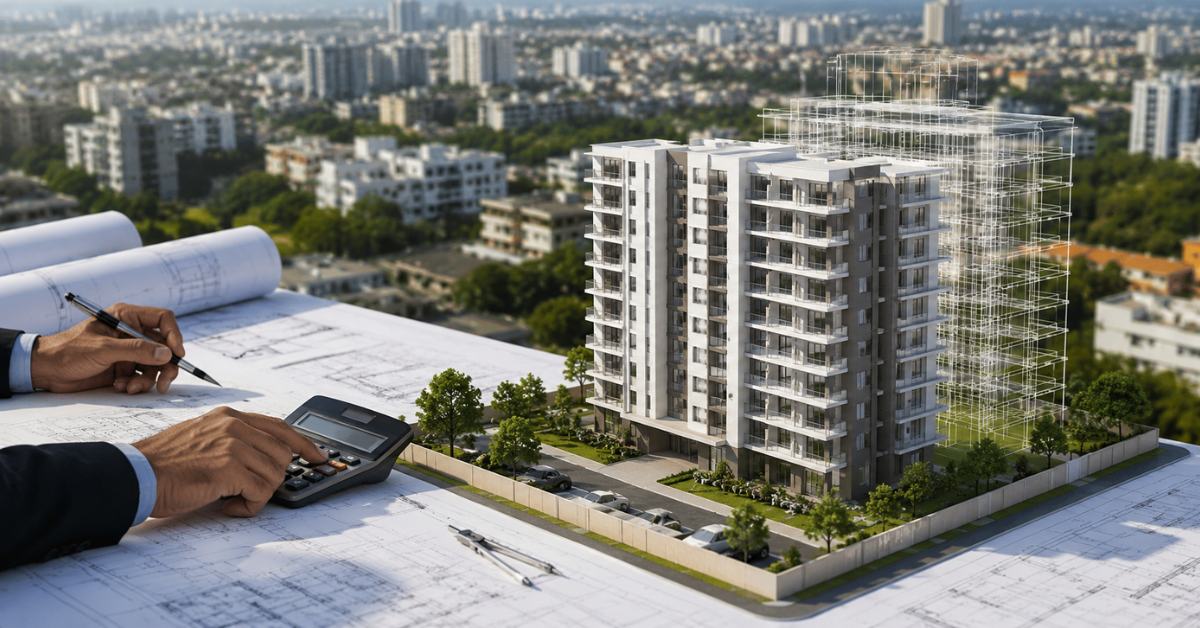
Real estate buyers often come across the term FSI. It appears in property brochures and legal documents. Many buyers do not fully understand its meaning. This guide explains FSI in real estate in simple terms. It covers the full form, meaning and calculation method. It also explains why FSI matters for buyers and developers. By the end, you will understand how FSI shapes construction and property value.
What Is FSI in Real Estate
FSI in real estate refers to Floor Space Index. It is a ratio that controls building construction on a plot. This ratio determines how much built-up area a developer can construct. Local municipal authorities set FSI limits for every zone. These limits vary based on location, infrastructure and land use.
FSI plays a central role in urban planning. It helps authorities manage population density in cities. It also ensures buildings do not overload local infrastructure. Roads, water supply and sewage systems all depend on population density. FSI keeps this density within manageable limits.
Every plot of land has an assigned FSI value. Developers must follow this value while planning construction. Exceeding the permitted FSI attracts penalties or demolition orders. This makes FSI a critical factor in every real estate project.
FSI Full Form in Real Estate
The FSI full form in real estate is Floor Space Index. Some regions also call it Floor Area Ratio, or FAR. Both terms describe the same underlying concept. Local authorities in India often use FSI as the standard term. Global markets, including the United States, commonly use FAR instead.
Understanding the full form helps buyers read property documents correctly. Builders often mention FSI compliance in project brochures. Knowing this term prevents confusion during property research.
FSI Meaning in Real Estate Explained Simply
The FSI meaning in real estate becomes clear through a simple analogy. Imagine a plot of land measuring 1,000 square feet. The local authority assigns this plot an FSI of 1.5. This means the developer can build 1,500 square feet of floor area. This area can spread across multiple floors.
FSI does not limit the plot to a single floor. It caps the total built-up area across all floors combined. A developer can choose to build one large floor. Alternatively, they can build several smaller floors within the same limit.
This ratio directly affects how tall or wide a building can be. Higher FSI values allow taller buildings on the same plot. Lower FSI values restrict construction to fewer floors. This is why FSI meaning matters so much in property planning.
How FSI Is Calculated
The FSI calculation formula is straightforward. It divides total built-up area by plot area. The formula looks like this:
FSI = Total Built-up Area ÷ Total Plot Area
Consider a practical example to understand this better. A plot measures 2,000 square feet in total area. The local authority permits an FSI of 2 for this zone. The developer can then construct 4,000 square feet of built-up area. This 4,000 square feet can spread across two or more floors.
Here is another example with a different FSI value:
- Plot area: 5,000 square feet
- Permitted FSI: 1.5
- Maximum built-up area: 7,500 square feet
This calculation excludes certain areas from the total. Balconies, stairwells and parking areas often fall outside FSI calculations. Different states apply different exclusion rules. Buyers should always verify local exclusion norms before assuming built-up area.
Developers use this formula to plan project layouts. Architects rely on FSI limits while designing floor plans. Municipal authorities check final construction against approved FSI values. Any deviation can lead to legal complications for the project.
Factors Affecting FSI Limits
Several factors influence the FSI value assigned to a plot. Municipal authorities consider these factors while framing zoning regulations.
- Location of the plot: Urban centers often receive higher FSI values than suburban areas. Cities need higher density to accommodate growing populations. Metro cities like Mumbai and Delhi have specific FSI zones. Tier 2 and tier 3 cities generally have lower FSI limits.
- Width of the abutting road: Wider roads support higher FSI values. Narrow roads restrict FSI because they cannot handle heavy traffic. This factor connects directly to infrastructure capacity.
- Availability of infrastructure: Areas with strong water supply and drainage systems get higher FSI. Authorities avoid granting high FSI in infrastructure-deficient zones. This prevents overload on existing civic amenities.
- Type of land use: Residential, commercial and industrial zones have different FSI norms. Commercial zones often receive higher FSI than residential zones. This reflects the different infrastructure needs of each land type.
- Government policies and master plans: City master plans define FSI limits for different zones. These plans undergo periodic revisions based on growth patterns. Government schemes sometimes offer additional FSI incentives. Affordable housing projects often receive bonus FSI benefits.
- Environmental considerations: Some zones face FSI restrictions due to environmental concerns. Heritage zones and eco-sensitive areas often have lower FSI limits. Authorities protect these areas by limiting construction density.
FSI vs FAR: Understanding the Difference
Many buyers confuse FSI with FAR. Both terms measure the same underlying concept. FSI stands for Floor Space Index. FAR stands for Floor Area Ratio. Indian real estate primarily uses the term FSI. International markets more commonly use FAR.
The calculation method remains identical for both terms. Both divide built-up area by plot area. The resulting ratio determines permissible construction. Buyers do not need to worry about functional differences between the two terms. They simply reflect regional naming conventions.
Some Indian states have started using both terms interchangeably. Reading property documents carefully helps clarify which term applies. Either way, the underlying calculation and purpose remain the same.
Read More: FAR in Real Estate
Types of FSI in Real Estate
FSI comes in different forms depending on how developers acquire it.
- Base FSI: Base FSI is the standard limit granted by municipal authorities. Every plot receives this base allocation automatically. Developers can construct up to this limit without additional approvals.
- Premium FSI: Premium FSI allows developers to build beyond the base limit. Developers pay an additional fee to the authority for this benefit. This fee typically depends on the ready reckoner rate of the area. Premium FSI helps developers maximize construction on limited land.
- Transferable Development Rights (TDR): TDR allows developers to purchase additional FSI from another location. This often happens when landowners give up land for public projects. In exchange, they receive TDR certificates. Developers can buy these certificates and use them elsewhere. This system helps balance development rights across a city.
- Incentive FSI: Authorities grant incentive FSI for specific project types. Affordable housing projects often qualify for this benefit. Redevelopment projects in old buildings also receive incentive FSI. This encourages developers to take up socially beneficial projects.
Understanding these FSI types helps buyers evaluate project legitimacy. Projects using premium FSI or TDR should show proper documentation. Buyers should always verify these approvals before purchasing a property.
FSI Regulations Across Indian Cities
FSI regulations vary significantly across Indian states and cities. Each municipal corporation frames its own FSI policy. These policies depend on local infrastructure and growth plans.
- Delhi: Delhi Development Authority regulates FSI across the city. Different zones in Delhi have different permitted FSI values. Master Plan Delhi 2021 and subsequent revisions guide these limits. Areas near metro corridors often receive higher FSI allowances.
- Mumbai: Mumbai has some of the most dynamic FSI policies in India. The city offers premium FSI and TDR extensively. High land scarcity makes FSI a critical factor in Mumbai real estate. Redevelopment projects in Mumbai heavily rely on incentive FSI.
- Bengaluru: Bengaluru Development Authority sets FSI based on road width and zone type. Commercial corridors in the city receive higher FSI values. Residential zones follow more conservative limits.
- Other growing cities: Cities like Gurugram, Noida and Pune have their own FSI frameworks. These frameworks evolve as infrastructure improves in these regions. Buyers should check the latest master plan for accurate FSI data.
Buyers must always confirm FSI norms with the local development authority. FSI policies change periodically through master plan revisions. Relying on outdated information can lead to incorrect assumptions.
Why FSI Matters for Homebuyers
Homebuyers often overlook FSI while evaluating a property. This ratio actually affects several important buying factors.
- Impact on open spaces and amenities: Lower FSI projects often have more open space. Developers cannot build excessive floor area on the same plot. This usually results in better ventilation and greenery within the project.
- Impact on building density: Higher FSI allows more units within the same project. This can mean more neighbors and higher building density. Buyers seeking privacy may prefer projects with moderate FSI.
- Impact on future resale value: Areas with potential FSI increases often see higher appreciation. Government plans to increase FSI can boost future property demand. Buyers researching FSI trends can make more informed investment decisions.
- Impact on legal compliance: Buyers should verify that a project follows approved FSI limits. Illegal construction beyond permitted FSI creates serious legal risks. Authorities can order demolition of unauthorised floors. Always ask developers for FSI compliance certificates before purchase.
- Impact on carpet area: FSI indirectly affects the carpet area offered to buyers. Projects with higher FSI may offer more units but smaller sizes. Understanding this connection helps buyers set realistic expectations.
Why FSI Matters for Developers
FSI directly determines a project’s profitability for developers. Higher FSI allows more saleable area on the same land. This improves the overall return on investment for the project.
Developers must balance FSI utilization with construction costs. Building additional floors under premium FSI requires extra investment. Developers calculate whether this investment justifies the additional saleable area.
FSI also influences project design and unit mix. Developers plan unit sizes based on total permissible built-up area. This directly shapes marketing strategy and target buyer segments.
Compliance remains critical throughout the development process. Developers must secure all necessary approvals before using premium FSI or TDR. Non-compliance can delay project completion and attract heavy penalties.
How to Check FSI for a Property
Buyers and developers can verify FSI details through official channels. Here are the common methods to check FSI:
- Visit the local municipal corporation website for zone-wise FSI data
- Check the city’s master plan document for detailed FSI norms
- Consult the local town planning department for specific plot queries
- Ask the developer for approved building plan documents
- Review the RERA registration details for FSI compliance information
RERA registration often includes details about permitted FSI usage. This document helps buyers confirm that a project follows legal norms. Cross-checking these details protects buyers from future legal disputes.
Impact of FSI on Property Prices
FSI has a direct relationship with property prices in any city. Higher FSI increases the total saleable area on a plot. This often reduces the per-unit land cost for developers. Lower land cost per unit can translate into competitive pricing for buyers.
However, higher FSI also increases construction costs and density. Developers pass on premium FSI charges to buyers through pricing. This means FSI benefits do not always translate into lower prices.
Locations with limited FSI often see slower supply growth. This can push property prices higher due to limited inventory. Buyers should study FSI trends alongside supply and demand patterns.
Future FSI revisions can also affect long-term property value. Areas expecting FSI increases often attract investor interest early. This anticipation itself can push prices upward before actual revisions occur.
Common Misconceptions About FSI
Many buyers hold incorrect assumptions about FSI. Clearing these misconceptions helps in better decision making.
| Misconception | Reality |
| Higher FSI always means better projects | Higher FSI does not automatically make a project better. It can result in increased density, more residents, and reduced open spaces. Buyers should assess overall project quality, amenities, design, and infrastructure rather than focusing only on FSI. |
| FSI and carpet area are the same | FSI (Floor Space Index) determines the total permissible built-up area on a plot, while carpet area refers to the actual usable floor area inside an individual unit. They are completely different measurements used for different purposes. |
| All developers can use unlimited premium FSI | Premium FSI is subject to maximum limits set by local authorities. Developers must follow these regulations and cannot exceed the prescribed caps even after paying premium charges. |
| FSI remains fixed forever | FSI regulations can change over time through updates to city master plans and development policies. Authorities may revise FSI limits based on infrastructure capacity, urban growth, and planning objectives. |
Role of FSI in Sustainable Urban Development
FSI plays a significant role beyond individual property transactions. It helps cities manage sustainable growth and infrastructure planning. Authorities use FSI to control population density in specific zones.
Balanced FSI policies prevent overcrowding in city centers. They also encourage development in suburban and peripheral areas. This distribution helps reduce pressure on core city infrastructure.
Many cities now link FSI incentives to sustainable construction practices. Green building certifications sometimes qualify for additional FSI benefits. This approach encourages developers to adopt eco-friendly construction methods.
Transit-oriented development also relies heavily on FSI policy. Areas near metro stations often receive higher FSI allowances. This encourages vertical growth near public transport corridors. It reduces urban sprawl and supports efficient land use.
FSI and Redevelopment Projects
FSI plays a crucial role in redevelopment projects across Indian cities. Old and dilapidated buildings often undergo redevelopment under revised FSI norms. Authorities frequently offer incentive FSI to encourage such projects.
Residents of old buildings benefit from these redevelopment schemes. Developers construct larger buildings using additional FSI incentives. This allows them to offer free or discounted units to existing residents. The extra saleable area helps developers recover project costs.
Mumbai has seen extensive redevelopment activity due to flexible FSI policies. Many other cities are now adopting similar redevelopment frameworks. Buyers interested in redevelopment projects should verify FSI approval documents carefully.
Conclusion
FSI in real estate plays a defining role in property development. It determines how much a developer can construct on any plot. Understanding FSI full form and meaning helps buyers make informed decisions. It also helps developers plan projects within legal boundaries.
FSI affects property density, pricing and long-term value. Buyers should always verify FSI compliance before finalizing a purchase. Checking official municipal records ensures complete transparency in property transactions.
Staying informed about FSI trends helps both buyers and investors. As cities grow, FSI policies will continue evolving to support sustainable development. A clear understanding of FSI ensures smarter and safer real estate decisions.
Understanding FSI helps you evaluate any project with more confidence. If you are exploring real estate options, our team can guide you further. Book a site visit today and see how these projects come to life on ground.
Frequently Asked Questions
1. What is FSI in real estate?
FSI, or Floor Space Index, is a ratio used in real estate. It determines the maximum built-up area allowed on a plot. Local municipal authorities set this ratio for every zone. It directly controls building height and construction density.
2. What is the full form of FSI in real estate?
The full form of FSI is Floor Space Index. It is also known as Floor Area Ratio, or FAR, in some regions. Both terms refer to the same construction ratio. Indian real estate commonly uses the term FSI.
3. How is FSI calculated for a property?
FSI is calculated by dividing total built-up area by plot area. For example, a 2,000 square foot plot with FSI 2 allows 4,000 square feet of construction. This built-up area can spread across multiple floors. Local exclusion rules may apply to certain spaces.
4. Why does FSI matter for homebuyers?
FSI affects building density, open spaces and legal compliance. Higher FSI projects often have more units and less open area. Buyers should verify FSI approval to avoid future legal issues. It also influences long-term property value and resale potential.