
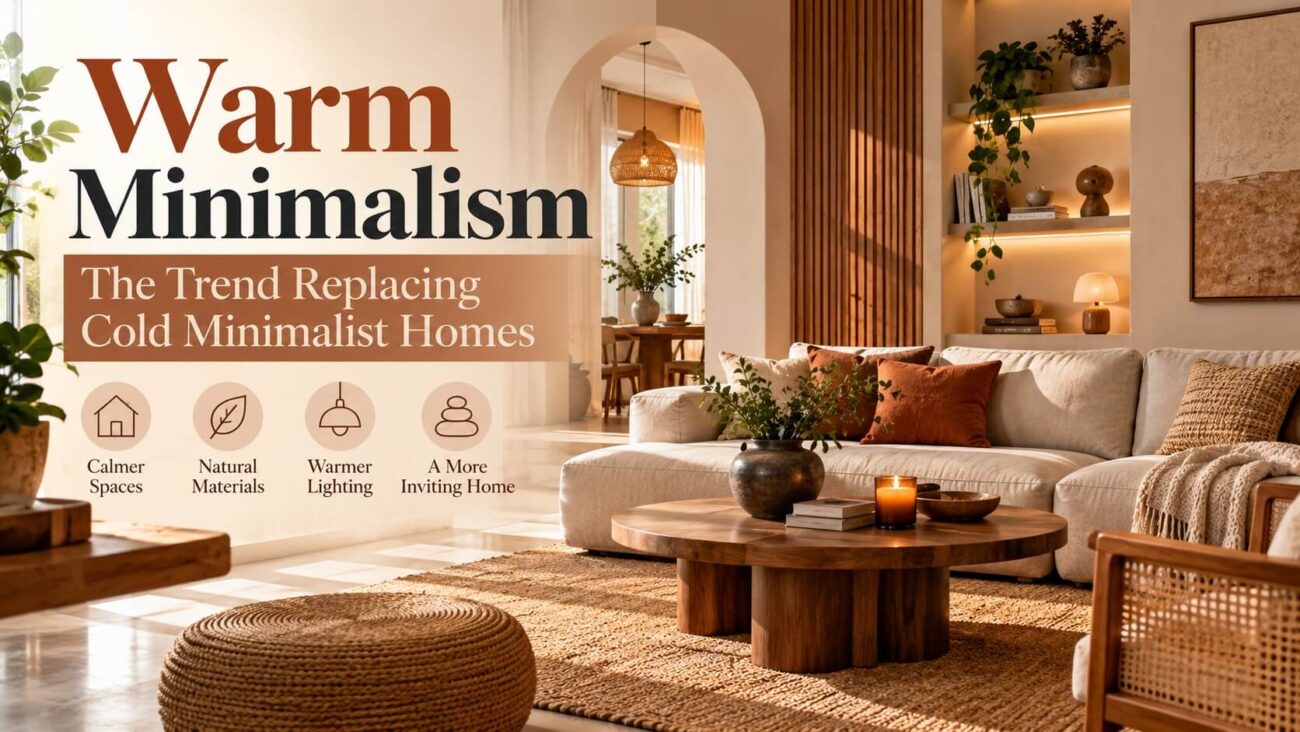
Walk into many minimalist homes, and you feel it at once. The walls are white. The sofa is grey. The room looks flawless, yet nobody wants to sit down.
Does that sound familiar? Many homeowners now admit that bare spaces feel like showrooms. They want calm, but they also want comfort.
That shift explains the rise of Warm Minimalism. The trend keeps the clean lines and clutter-free thinking of classic minimalism. It then adds softness, texture and earthy colour.
In this guide, you will learn what Warm Minimalism really means and how it suits Indian homes. You will also find tables, a room-by-room plan and a few lesser-known ideas.
What Is Warm Minimalism?
Warm Minimalism is a design approach that blends simplicity with comfort. You own fewer things, but each one feels inviting.
Cold minimalism leans on stark white, glossy surfaces and empty corners. This newer style leans on cream, sand, clay and wood. Light, texture and natural materials do the work.
Here is a simple way to see it. Cold minimalism asks, “What can I remove?” Warm Minimalism asks, “What do I truly need, and how can it feel good?”
The idea has deep roots. Japanese Zen interiors taught designers to value space and calm. Scandinavian homes added the cosy idea of hygge. Today’s trend borrows from both and adds local flavour.
Why Cold Minimalist Homes Are Losing Their Charm
Several reasons explain the change. Most of them come from how we live now.
Homes work harder than before. People cook, study, work and relax in the same flat. A sterile room cannot support that range of activity.
Indian homes also carry emotion. Families gather, festivals add colour, and guests drop in unannounced. An empty, rigid room rarely suits that rhythm.
Then comes the sensory problem. Hard surfaces bounce sound around the room. Cool white light flattens the mood. Evenings feel harsh instead of restful.
Screen fatigue plays a part too. After hours on a laptop, people crave tactile and natural surroundings.
Picture a Saturday evening in a bare white living room. The echo makes conversation tiring. The light feels like a hospital corridor. Now picture the same room with a wool rug, linen curtains and a lamp. Everyone stays longer.
Cold vs Warm Minimalism at a Glance
The table below shows the main differences.
| Feature | Cold Minimalism | Warm Minimalism |
|---|---|---|
| Wall colour | Stark white, cool grey | Cream, oat, sand, soft terracotta |
| Flooring | Glossy tiles, polished concrete | Wood, matte stone, jute rugs |
| Furniture | Sharp, metallic, rigid | Rounded, wooden, upholstered |
| Lighting | Cool white, overhead only | Warm, layered, low-level |
| Textiles | Few or none | Linen, cotton, wool, handloom |
| Decor | Almost nothing | A few meaningful objects |
| Mood | Formal and distant | Calm and welcoming |
The table makes one thing clear. This style never abandons order. It simply adds humanity.
The Warm Minimalism Colour Palette
Colour does most of the heavy lifting. Choose soft, earthy shades with a yellow or red undertone.
Use the 60-30-10 rule to keep the room balanced. Give 60 percent to a soft neutral on the walls. Give 30 percent to wood and fabrics. Reserve 10 percent for one bold earthy accent.
Avoid pure white paint where you can. Its high light reflectance causes glare, and it can look icy in north-facing rooms. Pick an off-white with a cream base instead.
| Shade | Where to use it | Mood it creates |
|---|---|---|
| Ivory and oat | Main walls, ceilings | Airy and gentle |
| Sand and beige | Sofas, curtains, rugs | Grounded and soft |
| Terracotta and rust | Cushions, one accent wall | Earthy and cheerful |
| Olive and sage | Plants, bedding, cabinets | Fresh and restful |
| Walnut and chestnut | Furniture, flooring | Rich and steady |
Materials That Bring the Warmth
Texture replaces decoration in this style. Instead of ten showpieces, you use a few honest materials.
Wood sits at the heart of the look. Teak, sheesham and mango wood all work well. Pick matte or oiled finishes over high gloss.
Soft fabrics come next. Linen curtains, cotton throws and wool rugs soften hard edges. Handloom and khadi fabrics add Indian character.
Natural fibres add depth. Jute rugs, cane chairs and rattan baskets bring light, airy texture. Many of these come from Indian craft clusters, such as Saharanpur for woodwork.
Handmade ceramics and terracotta finish the look. A slightly uneven pot adds charm. The Japanese idea of wabi-sabi celebrates exactly that imperfection.
Stone and muted brass offer contrast. Use them sparingly, perhaps on a coffee table or a lamp base.
Read More: Sheer curtain design ideas
The Lighting Secret Most People Miss
Here is a detail that many decor articles skip. Light colour matters as much as paint colour.
Bulbs carry a colour temperature measured in Kelvin. Lower numbers glow warm and yellow. Higher numbers look cool and blue.
A cream wall can look dull under a 6500K bulb. The same wall glows under a 2700K bulb. This small change decides whether your home feels cosy or clinical.
Layer your lighting, too. Combine a ceiling light, a floor lamp and a few table lamps. Keep most light sources low in the room.
| Room | Suggested colour temperature | Fixture idea |
|---|---|---|
| Living room | 2700K to 3000K | Floor lamp, wall sconce, dimmable ceiling light |
| Bedroom | 2200K to 2700K | Bedside lamps, warm strip light behind the headboard |
| Kitchen | 3000K to 4000K | Under-cabinet lights, pendant over the counter |
| Study | 3500K to 4000K | Adjustable desk lamp |
| Bathroom | 3000K to 4000K | Vanity light beside the mirror |
Use dimmers wherever possible. A dimmer lets one room serve breakfast, work and late-night reading.
The Sound of a Calm Home
Comfort is not only visual. Hard floors, bare walls and glass surfaces reflect sound, which creates echo. Soft furnishings absorb it.
Curtains, rugs, upholstered sofas and bookshelves all reduce that harsh ringing. Many people never notice the noise until it disappears. Then the home suddenly feels quieter and more restful. This is why textiles matter beyond looks.
A Room-by-Room Guide to Warm Minimalism
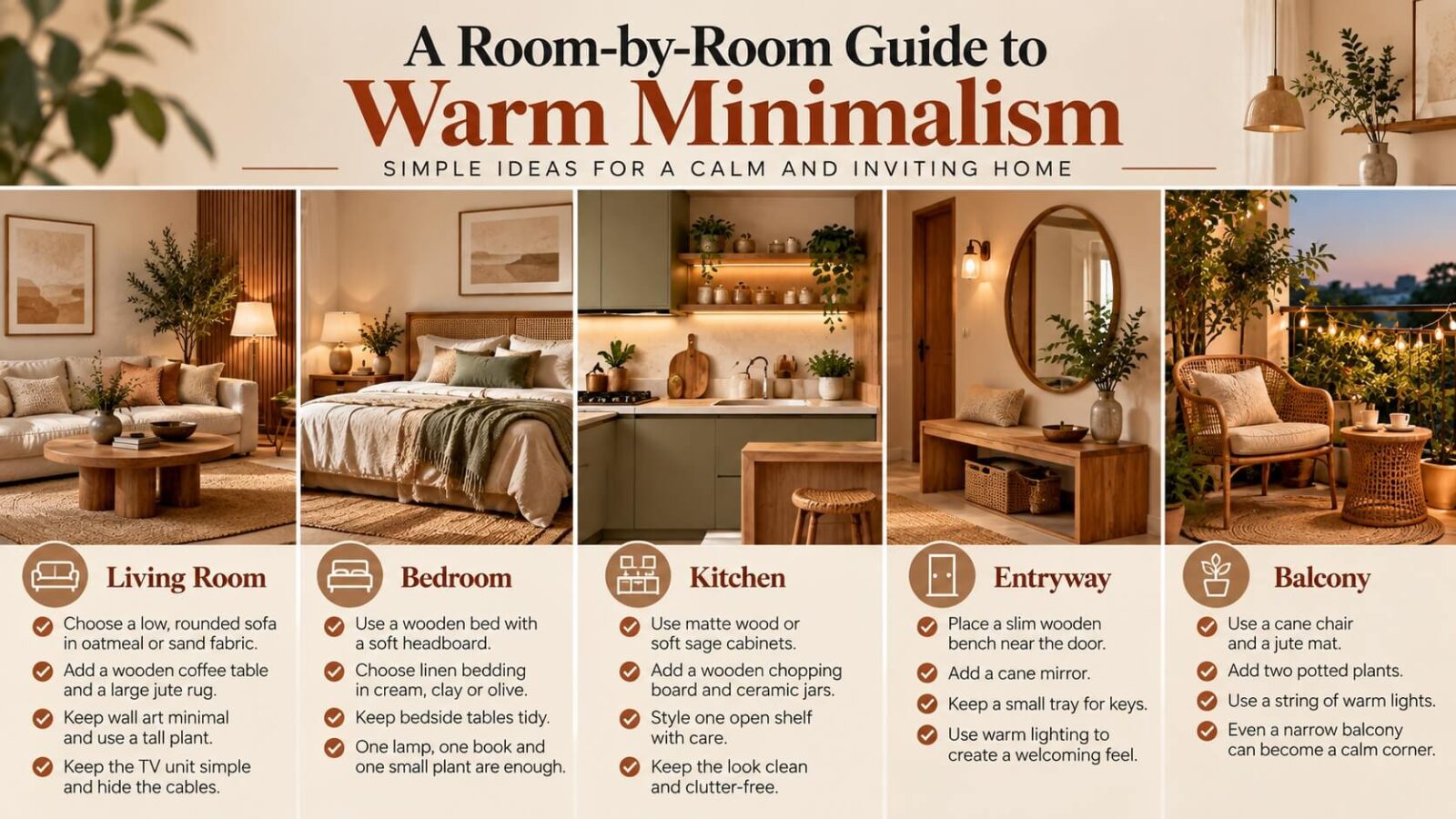
Every room needs a slightly different approach. Use these ideas as a starting point.
- Living room: Start with the sofa. Choose a low, rounded one in oatmeal or sand fabric. Add a wooden coffee table and a large jute rug.
- Limit wall art to one or two pieces. Let a tall plant fill the empty corner. Keep the TV unit simple, and hide the cables.
- Bedroom: The bedroom should feel like a quiet hug. Use a wooden bed with a soft headboard. Choose linen bedding in cream, clay or olive.
- Keep bedside tables tidy. One lamp, one book and one small plant are enough.
- Kitchen: Swap glossy white cabinets for matte wood or soft sage finishes. Add a wooden chopping board and a few ceramic jars. Style one open shelf with care.
- Entryway: Your entry sets the first impression. Place a slim wooden bench and a cane mirror near the door. Add a small tray for keys. Warm light here welcomes everyone.
- Balcony: Use a cane chair, a jute mat and two potted plants. Add a string of warm lights. Even a narrow balcony becomes a calm corner.
Read More: Living room decor ideas
Where Vastu Meets Warm Minimalism
Many readers ask whether modern trends fit Vastu principles. The answer is often yes.
Vastu traditions link earthy shades, such as beige, brown and yellow, with stability. Many practitioners suggest these tones for the south-west zone. The same shades sit at the centre of this trend.
Vastu also values open space and good natural light. A decluttered, softly lit home supports both ideas. The north-east corner works well with light shades and a clean, open feel.
Vastu guidance varies between experts. Check specifics with a qualified consultant before you make structural changes.
Read More: Wall texture design ideas
Warm Minimalism for Small Indian Flats
Compact homes in cities like Delhi NCR, Mumbai and Pune benefit most. The style reduces visual noise, so small rooms feel larger. Warm tones also make them feel cosier.
Try these space-friendly moves:
- Choose furniture with exposed legs. It shows more floor and feels lighter.
- Use one colour family across the living and dining areas.
- Pick storage beds and closed cabinets to hide daily clutter.
- Hang curtains from ceiling to floor. This adds visual height.
- Place mirrors opposite windows to bounce soft daylight.
There is a resale angle as well. Real estate agents often say that neutral, warm interiors appeal to more buyers. Buyers can easily picture their own furniture in such rooms.
Easy Weekend Swaps to Start Today
You do not need a full renovation. Small changes create a big shift.
| Swap | Effort | Impact |
|---|---|---|
| Replace cool white bulbs with warm LEDs | Very low | High |
| Add a jute rug under the sofa | Low | High |
| Change synthetic curtains to linen or cotton | Low | Medium |
| Group three ceramic pieces on a tray | Very low | Medium |
| Add a large indoor plant | Low | Medium |
| Repaint one wall in cream or sand | Medium | High |
| Replace glossy furniture with matte wood pieces | High | High |
Start with the first two. They cost little and change the mood fast.
A Five-Step Plan for Beginners
Follow this order if you feel overwhelmed.
- Declutter one room completely.
- Fix the lighting with warm bulbs and one lamp.
- Add one large textile, such as a rug.
- Bring in wood and one plant.
- Stop, live with the room for a week, then adjust.
Patience matters here. A warm home grows slowly, and rushing leads to clutter.
Read More: 1 BHK interior design ideas
Common Mistakes to Avoid
Even a good idea can go wrong. Watch for these errors.
- Too much beige. A room with one shade turns flat and dull. Add contrast through dark wood, black metal or deep green.
- Skipping texture. Smooth, matching surfaces look lifeless. Mix at least three textures in each room.
- Over-decorating. Warm does not mean crowded. Let your surfaces breathe.
- Matching every wood tone. Perfect matches look forced. Pair two or three related tones for a natural look.
- Ignoring lighting. The best paint cannot save a harsh bulb.
A Quick Declutter Checklist
Clear the space before you add warmth. Use this checklist.
- Remove items you have not used in a year.
- Clear kitchen counters except for daily essentials.
- Keep only one decorative tray on each surface.
- Store seasonal items in labelled boxes.
- Dedicate one “joy shelf” to sentimental objects.
The joy shelf deserves a note. You still keep the souvenirs, the childhood trophy and the odd clay figure. You simply give them one proper home.
Read More:False ceiling lighting ideas
Is This Just a Passing Trend?
Trends come and go. This one rests on lasting ideas, though. Natural materials, soft light and fewer, better things never really go out of style.
That is why it feels more like a mindset than a fashion. You can start small, build slowly and adapt it to your own taste.
Own the style rather than copying a catalogue. Add your grandmother’s brass lamp or a hand-painted pot from your travels. Those personal pieces make Warm Minimalism feel like your home.
Looking for more home decor ideas, Vastu tips and housing updates? Explore Zen Nest Living for practical guides on interiors, real estate, housing schemes, tech and gaming. Visit Zen Nest Living today, and turn every corner of your home into a calm, welcoming space.
FAQs
Q1. What is Warm Minimalism in interior design?
Warm Minimalism is a style that combines clean, clutter-free spaces with soft textures, earthy colours and warm lighting. It keeps the calm of minimalism but adds comfort.
Q2. Which colours suit Warm Minimalism?
Cream, ivory, sand, oatmeal, terracotta, olive and walnut brown suit this style. Avoid stark white and cool grey, because they make rooms feel distant.
Q3. Can I follow Warm Minimalism in a rented flat?
Yes. Focus on removable changes such as warm bulbs, rugs, curtains, bedding and plants. These upgrades need no drilling or repainting, and you can take them along when you move.
Q4. How is Warm Minimalism different from Japandi?
Japandi blends Japanese and Scandinavian design with a muted, restrained palette. This broader style also welcomes terracotta, handloom fabrics and local crafts, so it suits Indian homes easily.
