

Walk into a well-planned Japandi room and your shoulders drop. The air feels quieter. Nothing demands your attention.
Japandi style joins Japanese restraint with Scandinavian warmth. Indian homes, with their love of natural materials, adapt to it more easily than most people expect.
Picture a Pune flat with one low teak bench, a clay vase, and a cotton rug. The room feels larger than the neighbour’s flat, which holds twice the furniture.
This guide shows you how to create that effect. You will find colours, textures, furniture tips, Vastu pointers, and a few India-specific ideas that global guides skip.
What Is Japandi Style?
The name blends Japan and Scandinavia. Designers in both regions have admired each other’s craft for over a century. Today, Japandi style sits where two design philosophies meet.
Scandinavian design prizes hygge, a feeling of cosy comfort. Japanese design prizes wabi-sabi, which finds beauty in age and imperfection. Together, they create rooms that feel calm and lived in.
Three ideas hold everything together. Function comes first. Natural materials lead. Imperfection is welcome.
| Element | Scandinavian | Japanese | Japandi |
|---|---|---|---|
| Mood | Cosy and bright | Quiet and reflective | Warm and serene |
| Palette | White, pale wood, soft grey | Earth tones, black, moss | Warm neutrals with deep accents |
| Furniture | Slim legs, rounded edges | Low, grounded, joinery-led | Low, clean, visibly crafted |
| Decor | Textiles and candles | One object, much space | Few handmade pieces |
| Flaws | Repair them | Celebrate them | Celebrate them, stay comfortable |
Notice the shared ground. Both cultures respect craft, simplicity, and honest materials.
Read More: Warm Minimalism
Why Japandi Style Suits Indian Homes
Indian homes already practise many of these habits. Families remove shoes at the door. Many sit on the floor during festivals. Brass vessels darken with age, and nobody complains.
Four local factors make the match stronger.
- Climate: Breathable wood and cotton suit hot, humid weather.
- Space: Compact flats gain a lot from edited furniture.
- Craft: Handloom and pottery traditions supply the handmade look.
- Vastu: Clear floors and natural light echo Vastu advice on free-flowing energy.
The Indian Wabi-Sabi Map
Many Japandi style guides copy Japanese references one to one. You can do better. India has a close cousin for almost every Japanese idea.
These cousins cost less, ship faster, and carry real regional stories.
| Japanese idea | Indian cousin | How to use it |
|---|---|---|
| Sashiko stitching | Kantha embroidery | Throw over a sofa arm |
| Shibori dyeing | Bandhani and indigo block prints | Muted cushion covers |
| Shoji screens | Jaali panels | Room dividers, pooja unit doors |
| Hand-thrown stoneware | Longpi pottery, Khurja ceramics | Vases and dinnerware |
| Tatami floor seating | Gaddi and chowki | Low seating with bolsters |
| Wabi-sabi ageing | Unlacquered brass and kansa | Diyas and serving bowls |
Start with one pair. A kantha throw on a plain sofa already shifts the mood.
Read More: Texture Layering Ideas
Choosing a Calm Colour Palette
Japandi style leans on warm neutrals. Begin with soft whites. Add oatmeal, sand, and clay. Finish with one dark accent, such as charcoal or deep indigo.
Follow the 60-30-10 rule. Use 60 percent base neutrals, 30 percent wood and fabric tones, and 10 percent dark accents.
Indian sunlight changes paint dramatically. A white that looks creamy at 10 am can turn yellow by evening. Test swatches on two walls and check them at 10 am and 6 pm.
Avoid cool bluish whites. They feel clinical, especially under tube lights.
Layering Neutral Interior Textures
Colour stays quiet in this look, so texture does the talking. Neutral interior textures stop a pale room from feeling flat.
Japandi style depends on touch as much as sight. Aim for three textures in every room. Mix one rough, one soft, and one smooth surface.
- Rough: lime wash plaster, jute rugs, unpolished stone.
- Soft: linen, khadi, handloom cotton, wool throws.
- Smooth: matte ceramics, oiled wood, Kota stone.
Skip high gloss. Shiny laminates and glossy tiles break the mood instantly. Neutral interior textures also hide daily wear. A slubby linen cover forgives chai spills better than flat white cotton.
Read More: Living Room Decor Ideas
Building a Japanese Scandinavian Living Room
A Japanese Scandinavian living room starts with one low, quiet anchor. Choose a sofa with a seat height near 16 inches. Pick oatmeal linen or textured cotton.
Pair it with a low coffee table in ash, teak, or sheesham. Keep the top nearly bare. One bowl and one book are enough.
Light matters more than most people think. Replace cool tube lights with warm bulbs between 2700K and 3000K. Add a paper-shade floor lamp for a soft evening glow.
In Japandi style, empty space counts as a feature. Leave about one third of your wall space bare. Japanese designers call this pause ma. It lets the eye rest.
Skip the plant jungle. One sculptural plant, or a single branch in a clay vase, works better.
Many Indian living rooms also host meals or prayers. Use a low bench or a jaali panel to separate zones gently. Keep the path to the main door clear.
A Japanese Scandinavian living room can work even in a 10 by 12 foot space. You simply edit harder.
Read More: Vastu for Pooja Room
Picking Furniture That Lasts
Shop for form and joinery, not labels. Japandi style favours slim, grounded pieces with visible grain. Look for rounded corners, tapered legs, and exposed joints.
| Material | Why it works | Watch out for |
|---|---|---|
| Teak | Durable, warm grain, handles moisture | Higher price |
| Sheesham | Rich grain, widely available | Needs proper seasoning to avoid warping |
| Mango wood | Affordable and sustainable | Softer, so it dents easily |
| Ash or oak | Pale, true Scandinavian tone | Often imported and costly |
| Cane and rattan | Light and breathable | Needs dry corners and gentle cleaning |
| Bamboo | Strong and fast growing | Cheap versions split |
Smart Online Buying
Searching for Japandi furniture online India brings plenty of choice. Photos can mislead, though. Check five things before you pay.
- Wood type: solid or engineered.
- Finish: matte oil or low-VOC polish.
- Size: tape the dimensions on your floor first.
- Policy: read the damage and return terms.
- Samples: request a fabric swatch or wood sample.
Coastal buyers in Mumbai, Chennai, or Kochi should favour seasoned solid wood. Cheap engineered boards swell during monsoon humidity.
Japandi furniture online India listings now include small workshops. Compare them with big marketplaces before deciding.
Where Vastu and Japandi Agree
The two systems share more than you might guess. Vastu asks you to keep the centre of the home, the Brahmasthan, open and clutter-free. This rule matches the Japanese love of empty space.
Vastu also favours light colours and generous daylight in the north and east. Warm neutrals and sheer linen curtains support that advice.
Place heavier furniture, such as wardrobes and large sofas, along the south or west walls. Keep the northeast corner light, clean, and calm.
Treat these as guidelines, not strict rules. Your floor plan, family needs, and budget matter too.
Room-by-Room Ideas
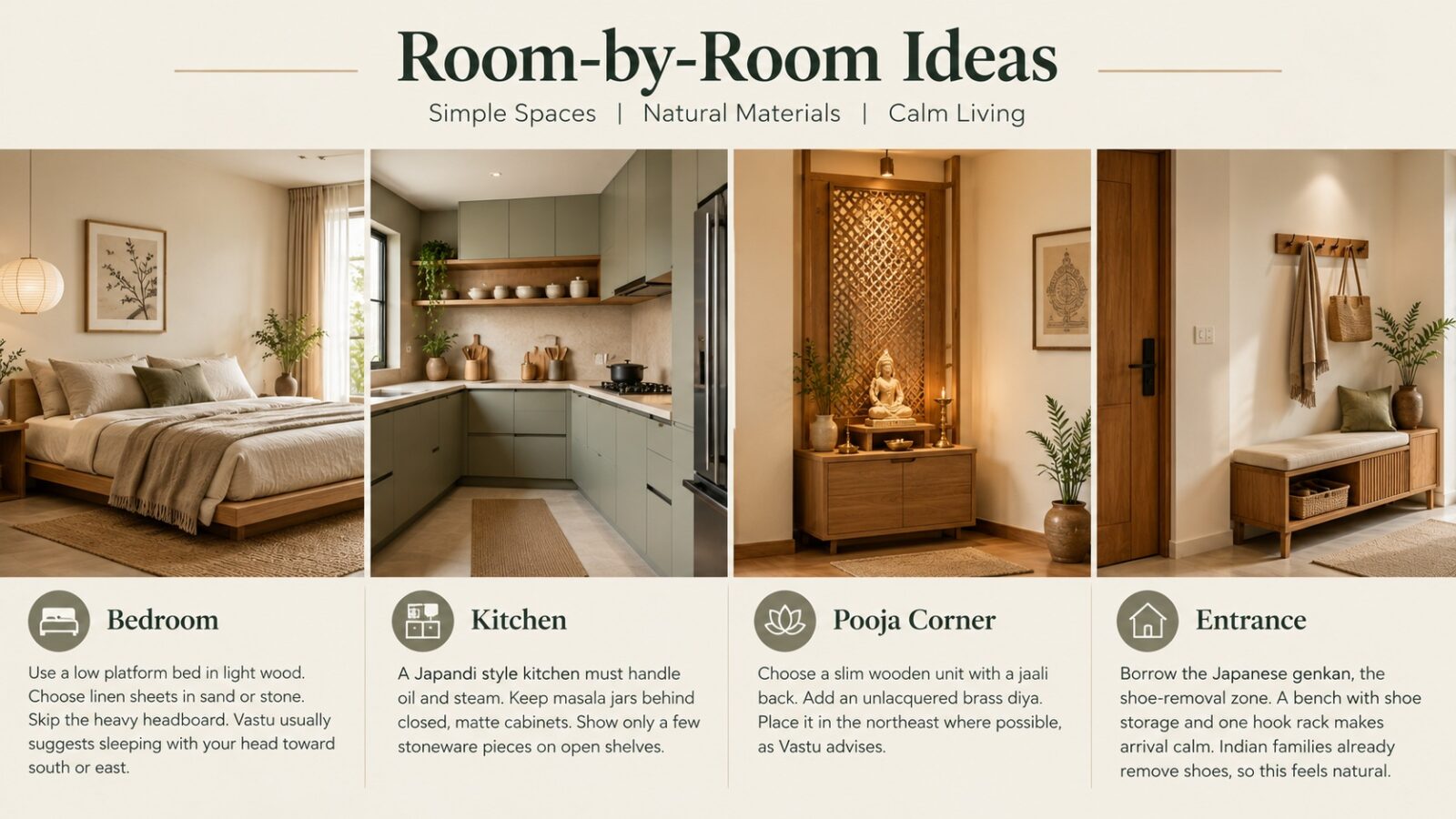
Bedroom
Japandi style in the bedroom means a low platform bed in light wood. Use linen sheets in sand or stone. Skip the heavy headboard. Vastu usually suggests sleeping with your head toward south or east.
Kitchen
A Japandi style kitchen must handle oil and steam. Keep masala jars behind closed, matte cabinets. Show only a few stoneware pieces on open shelves.
Pooja Corner
Japandi style also respects sacred corners. Choose a slim wooden unit with a jaali back. Add an unlacquered brass diya. Place it in the northeast where possible, as Vastu advises.
Entrance
Borrow the Japanese genkan, the shoe-removal zone. A bench with shoe storage and one hook rack makes arrival calm. Indian families already remove shoes, so this feels natural.
Caring for Natural Materials in Indian Weather
Natural materials need a little attention. The reward is a patina that improves every year.
- Keep wooden furniture two to three centimetres away from walls. This gap lets air move and reduces damp patches.
- Wipe wood with a dry or barely damp cloth. Apply a suitable wood oil to teak once or twice a year.
- Air jute rugs in the sun now and then. Moisture makes them smell musty.
- Wash linen on a gentle cycle and dry it in shade. Strong sun fades the colour quickly.
- Accept small marks. A ring from a chai cup is part of the story.
Common Mistakes to Avoid
Japandi style fails when it turns into a showroom. Avoid these errors.
- Copying Japan too literally: Skip fake bonsai and bamboo-print cushions. Let Indian craft lead.
- Too much beige: Add charcoal or moss to ground the room.
- Ignoring storage: Minimalism needs hidden cabinets, or clutter wins.
- Buying imitations: One solid wood piece beats five laminated ones.
- Fixing every flaw: A small scratch on a table adds character.
Build It in Stages
You can build Japandi style without redoing the whole home. Work in three stages.
| Stage | What to do | Indicative budget |
|---|---|---|
| One | Declutter, swap bulbs, add linen covers | Under Rs 10,000 |
| Two | Add a jute rug, paper lamp, and low bench | Rs 15,000 to Rs 50,000 |
| Three | Replace the sofa and table with solid wood | Rs 60,000 and above |
Prices vary by city, brand, and wood type. Treat these figures as rough guides.
Final Thoughts
Japandi style is a habit, not a shopping list. Remove one item each week. Add one handmade piece each month. Within a season, your home will feel calmer, lighter, and more like you. For more home decore, vastu and real estate information, visit Zen Nest Living.
Frequently Asked Questions
1. What is Japandi style in simple words?
It mixes Japanese minimalism with Scandinavian comfort. The look uses natural materials, muted colours, low furniture, and very little clutter. Handmade and imperfect pieces are welcome.
2. Is Japandi style expensive for Indian homes?
Not necessarily. Begin with decluttering, warm lighting, and linen covers. Add solid wood pieces slowly. Sheesham and mango wood often cost less than imported oak, and local craftspeople can offer fair prices.
3. Which colours suit a Japandi living room in India?
Warm whites, oatmeal, sand, and clay form the base. Add charcoal, deep indigo, or moss green in small doses. Test paint in your own daylight before committing.
4. Can I mix Japandi with traditional Indian decor?
Yes. Brass diyas, jaali panels, kantha throws, and handloom cushions fit well. Keep the quantity low and the quality high. Let each piece breathe.
