
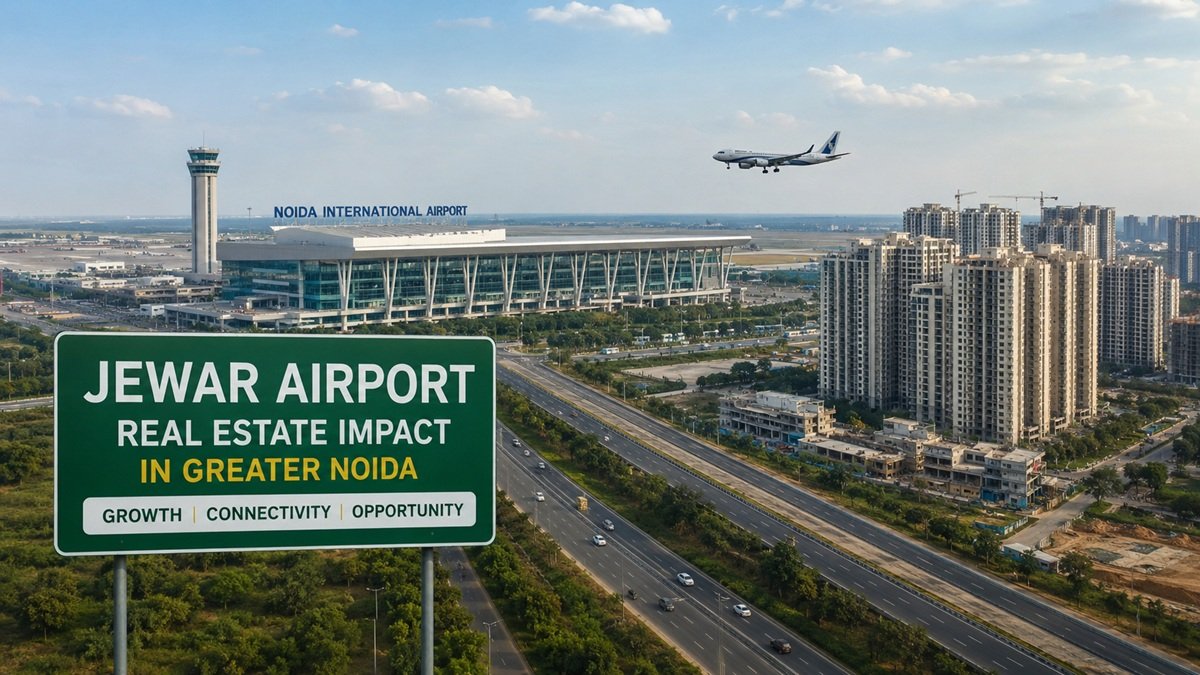
Jewar Airport has changed the way people look at real estate in Greater Noida. This single infrastructure project has turned a quiet expressway belt into one of the most watched property corridors in the National Capital Region. Homebuyers, investors, and developers are all tracking the ripple effect of Jewar Airport on land values, housing demand, and future infrastructure.
Prime Minister Narendra Modi inaugurated Phase 1 of Noida International Airport on 28 March 2026. The Directorate General of Civil Aviation had already granted the aerodrome licence in early March 2026, clearing the final regulatory hurdle. Domestic commercial flights began in the following months, with major carriers including IndiGo, Akasa Air, and Air India Express operating routes from the new terminal. International flights are expected to follow later in 2026, with a full winter international schedule targeted for October.
This blog explains how Jewar International Airport is reshaping the real estate landscape of Greater Noida, why property values along the Yamuna Expressway are climbing, and what buyers should know before making an investment decision.
Why the Airport Story Matters for Buyers Right Now
Every major city in India shows the same pattern once an international airport becomes operational nearby. Land close to the terminal gains value first, then the effect spreads outward to residential sectors, retail hubs, and office corridors. Greater Noida sits close enough to benefit from this pattern within the next few years, rather than waiting a decade for the effect to reach it.
Understanding the Scale of the Project
Noida International Airport sits on roughly five thousand hectares in Gautam Buddh Nagar district, close to the Yamuna Expressway. Phase 1 includes a single runway and terminal, built to handle twelve million passengers a year. Once all four phases are complete, the airport will handle up to seventy million passengers annually, making it one of the largest aviation hubs in Asia.
The scale of Jewar Airport matters because large airports do not just move people. They pull in logistics companies, maintenance and overhaul facilities, hospitality chains, and export businesses. Each of these sectors needs office space, warehousing, and housing for a growing workforce. Greater Noida sits close enough to absorb a large share of this demand.
Why Greater Noida Benefits the Most
Greater Noida lies roughly forty to sixty minutes from the airport site, connected directly through the Yamuna Expressway. This proximity places it firmly inside the growth radius that planners and developers are targeting.
Several factors make Greater Noida the natural beneficiary of the Jewar Airport effect. Wide six-lane roads already connect the city to the expressway. Sector planning in Greater Noida West and along the Yamuna Expressway leaves room for large residential townships. Metro connectivity is expanding, linking the city more closely with Noida and Delhi. Land here also remains considerably cheaper than established markets such as Gurugram or South Delhi, giving buyers room for future appreciation.
Developers have responded quickly. New residential launches across Greater Noida West, Sector 1, Sector 4, and the Yamuna Expressway corridor are aimed squarely at buyers who want to be close to Jewar Airport without paying Noida city centre prices.
Connectivity is improving alongside the airport itself. Road widening projects, planned metro extensions, and the upcoming Faridabad-Jewar Expressway all point towards a corridor built around one central idea, keeping Greater Noida within easy reach of the terminal. For buyers, this means a home purchased today could sit inside a well-connected suburb within a few years, rather than a distant expressway township.
Read More: Delhi to Jewar Airport Route
The Price Trend So Far
Property consultants have tracked a sharp rise in prices across Noida and Greater Noida even before commercial operations began. Residential values in this belt rose sharply between 2020 and 2025, driven largely by anticipation of the airport opening. Plot prices along the Yamuna Expressway climbed from around one thousand one hundred rupees per square foot in 2020 to close to three thousand rupees per square foot by 2025.
Since the inauguration of Jewar Airport, market experts have forecast a further rise of fifteen to twenty per cent across residential pockets over the next year or two. Some analysts believe prices in micro-markets closest to the airport could double within five to six years, though this pace will depend on how quickly commercial and industrial activity picks up around the terminal.
It is worth noting that not every pocket will see uniform growth. Industry voices have cautioned that some areas saw speculative buying push prices beyond what current fundamentals support. Buyers should treat Jewar Airport as a long-term growth driver rather than a guarantee of overnight profit.
Price growth also tends to move in phases rather than a single jump. The first phase came from anticipation before construction finished. The second phase is now building around the inauguration and the start of commercial flights. A third phase, likely the strongest, should follow once international flights, cargo operations, and the surrounding commercial zones are fully functional.
Commercial and Industrial Spillover
An international airport of this size does not benefit housing alone. Noida is already seeing a rise in Grade A office leasing, with consultants projecting several million square feet of annual absorption from 2026 onwards. A large share of this demand is tied directly to the presence of Noida International Airport and the logistics, aviation, and export ecosystem forming around it.
Warehousing and industrial land along the Yamuna Expressway are also drawing strong interest. Companies handling cargo, cold storage, and maintenance work want to be close to Jewar Airport rather than relying solely on Delhi’s existing airport. This industrial pull creates jobs, and jobs create housing demand in nearby residential sectors.
What This Means for Homebuyers
For someone buying a home in Greater Noida today, the presence of Jewar Airport changes the investment calculation in several ways.
First, connectivity improves the daily commute for residents who travel for work or business. Second, rental demand is likely to rise as airport staff, airline employees, and logistics workers look for housing close to their workplace. Third, resale value gains extra support from an infrastructure asset that keeps generating economic activity for decades.
Buyers should still apply the same due diligence they would use for any major purchase. Checking RERA registration, verifying land titles, confirming builder track record, and reviewing the actual construction timeline remain essential steps. Airport-driven optimism should never replace basic homework on a property.
Location within the corridor also matters more than proximity to the airport alone. A sector with completed roads, working sewage systems, and nearby schools will outperform a sector that only offers a shorter drive to Jewar Airport but lacks basic civic infrastructure. Buyers should weigh both factors together rather than choosing on distance alone.
What This Means for Investors
Investors looking at plots or apartments near the airport corridor are drawn by the possibility of long-term capital appreciation. Early entry into a growth corridor historically delivers stronger returns than buying after infrastructure is fully operational and prices have already adjusted.
The Yamuna Expressway Industrial Development Authority has also rolled out plot schemes in recent years, giving investors a direct route to land ownership in this belt. These schemes typically draw heavy interest given their link to the airport story.
Investors should still diversify and avoid putting all capital into a single micro-market. Diversifying between Greater Noida West, Yamuna Expressway plots, and established Noida sectors spreads risk while still capturing airport-linked upside.
The Road Ahead
A few upcoming developments will shape how quickly Greater Noida absorbs the benefits of Jewar Airport. The Faridabad-Jewar Expressway is expected to open between late 2026 and early 2027, improving connectivity from Haryana. International cargo operations are set to go live later in 2026, adding another layer of commercial activity. Hotel zones, MRO facilities, and a second wave of airline operations are all planned for 2027 and beyond.
Each of these milestones adds fresh momentum to the real estate story unfolding around Jewar Airport. Greater Noida, sitting at the heart of this corridor, is positioned to capture a large share of the resulting demand for housing, retail, and commercial space.
Retail and hospitality brands are also watching this corridor closely. Hotels, service apartments, and food and beverage chains typically follow passenger volumes, and rising footfall at Jewar Airport should encourage new commercial development within nearby residential townships. This adds another income stream for investors who choose mixed-use projects over purely residential ones.
Final Thoughts
Jewar Airport is more than an aviation project. It is reshaping how people choose where to live, work, and invest across Greater Noida and the wider Yamuna Expressway belt. Property prices have already responded to years of anticipation, and further growth looks likely as flight operations expand and commercial activity builds around the terminal.
Anyone considering a purchase in this corridor should track official updates closely, verify every legal detail, and think in terms of a five to ten year horizon rather than quick gains. The fundamentals behind Greater Noida real estate, improved connectivity, expanding job creation, and a growing aviation hub next door, remain strong for the years ahead.
Ready to explore homes near this upcoming growth corridor? Zen Nest Living helps you compare verified listings, understand micro-market trends, and connect with trusted developers across Greater Noida and the Yamuna Expressway. Start your search today and make an informed move towards your next home. For more information related to price trends around Jewar International Airport, contact us.
Frequently Asked Questions
1. When did Jewar Airport officially open?
Prime Minister Narendra Modi inaugurated Phase 1 of Noida International Airport on 28 March 2026, following the aerodrome licence granted by the Directorate General of Civil Aviation earlier that month.
2. How far is Greater Noida from Jewar Airport?
Greater Noida sits roughly forty to sixty minutes from the airport site, connected directly through the Yamuna Expressway, which places it within the immediate growth radius of the project.
3. Will property prices in Greater Noida keep rising after the airport launch?
Market experts forecast further gains of fifteen to twenty per cent over the next year or two, with some micro-markets closest to the airport potentially doubling in value over five to six years, though growth will vary by location and infrastructure readiness.
4. Is it still a good time to invest near Jewar Airport?
Early entry into an infrastructure-led growth corridor has historically delivered stronger long-term returns, but buyers should verify RERA registration, land titles, and builder credentials before committing to any purchase.