
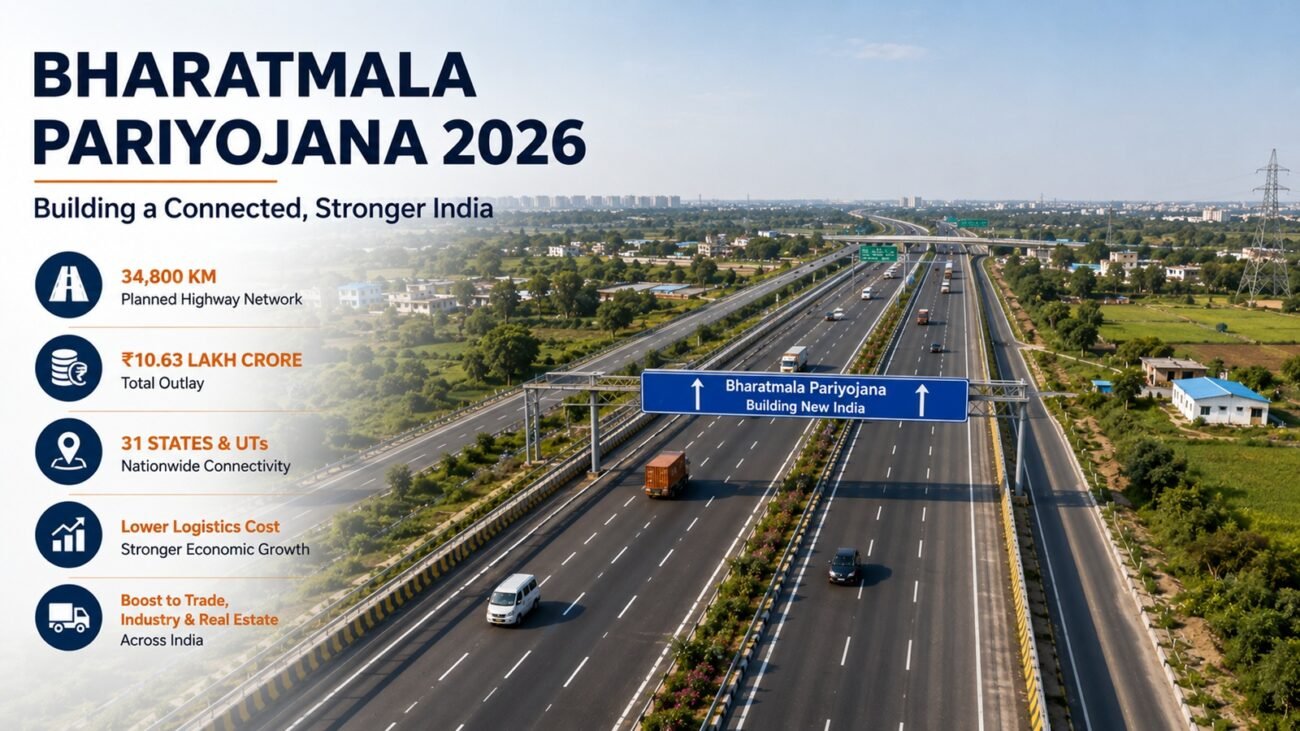
India’s road network is undergoing a massive transformation. Bharatmala Pariyojana sits at the heart of this change. Launched by the Ministry of Road Transport and Highways, Bharatmala Pariyojana aims to connect the entire country through modern highways. This guide explains the objective, features, phases, and current progress of Bharatmala Pariyojana in simple terms.
What is Bharatmala Pariyojana
Bharatmala Pariyojana is an umbrella highway development programme launched in 2017. The scheme falls under the Ministry of Road Transport and Highways. It focuses on building economic corridors, feeder routes, and border roads. Bharatmala Pariyojana also covers coastal connectivity and expressway development. The programme was approved with an outlay of around Rs 10.63 lakh crore. It targets the construction of nearly 34,800 km of national highways. Bharatmala Pariyojana works alongside the PM Gati Shakti plan for better logistics.
What is the Main Objective of the Bharatmala Pariyojana
The main objective of the Bharatmala Pariyojana is to improve freight movement across India. It aims to reduce logistics costs for businesses and industries. Bharatmala Pariyojana also seeks to connect remote and border regions with the mainland. Another key objective is boosting trade through better port and airport connectivity. The scheme wants to reduce travel time between major economic centres. It further plans to strengthen road infrastructure near industrial clusters. Bharatmala Pariyojana also focuses on reducing traffic congestion in cities. Overall, the objective is faster, cheaper, and safer road transport nationwide.
Key Features of Bharatmala Pariyojana
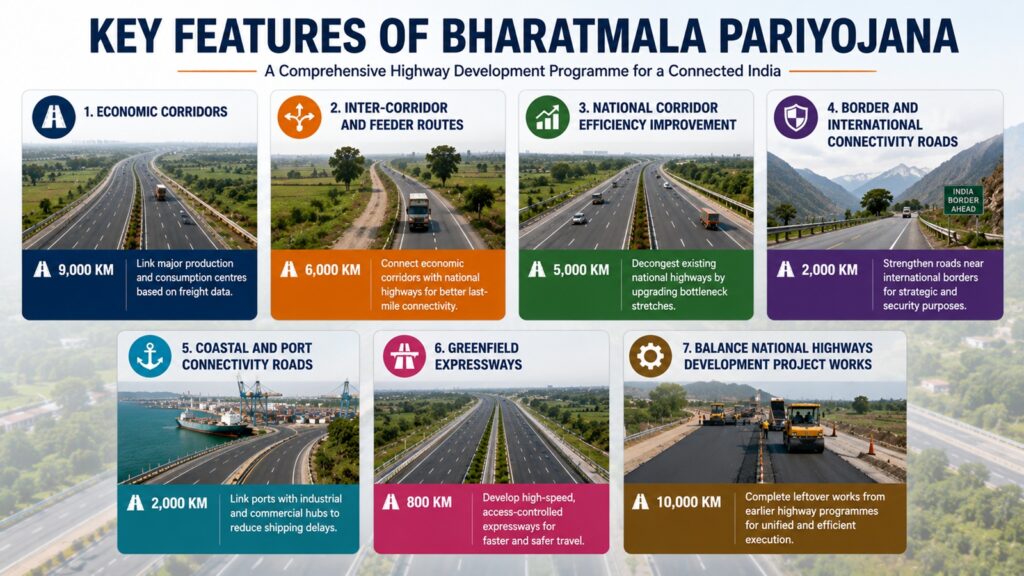
Bharatmala Pariyojana covers several categories of road development. Each category serves a specific connectivity purpose across the country.
- Economic Corridors: This component covers around 9,000 km of roads. These corridors link major production and consumption centres. Bharatmala Pariyojana identifies these corridors based on freight movement data.
- Inter-Corridor and Feeder Routes: This segment spans nearly 6,000 km. These routes connect economic corridors with national highways. They improve last-mile connectivity for goods transport.
- National Corridor Efficiency Improvement: This part covers around 5,000 km. It focuses on decongesting existing national highways. Bharatmala Pariyojana upgrades bottleneck stretches under this component.
- Border and International Connectivity Roads: This category spans about 2,000 km. It strengthens roads near international borders. Bharatmala Pariyojana considers these roads strategically important for security.
- Coastal and Port Connectivity Roads: This segment covers roughly 2,000 km. It links ports with industrial and commercial hubs. Better port access reduces shipping delays significantly.
- Greenfield Expressways: This component includes around 800 km of new expressways. These roads offer high-speed, access-controlled travel. Bharatmala Pariyojana treats expressways as a growth priority.
- Balance National Highways Development Project Works: This covers about 10,000 km. These are leftover works from earlier highway programmes. Bharatmala Pariyojana absorbed these projects for unified execution.
Read More: Delhi Dehradun Expressway
Bharatmala Pariyojana Phase 1 Progress
Phase 1 of Bharatmala Pariyojana was originally planned between 2017 and 2022. The phase covers 34,800 km across 31 states and union territories. It spans more than 550 districts nationwide. By March 2024, the programme had awarded contracts for over 26,000 km and completed more than 17,000 km, with expenditure crossing Rs 4.5 lakh crore. The Delhi-Mumbai Expressway is a flagship project under this phase. The Mumbai-Nagpur Expressway also falls under Bharatmala Pariyojana Phase 1. Several coastal routes have been completed or are nearing completion. Nearly half of Phase 1 was complete as of March 2024. Full completion is expected by 2027-28. Delays occurred due to land acquisition issues and cost overruns. The COVID-19 pandemic also slowed down construction timelines. Despite delays, Bharatmala Pariyojana has reshaped India’s highway landscape significantly.
Bharatmala Pariyojana Phase 2 Details
Bharatmala Pariyojana Phase 2 is currently in the planning and approval stage. This phase focuses on nearly 8,500 km of new corridors. The estimated investment stands around Rs 3.5 lakh crore. Earlier estimates suggested over 8,100 km across six expressways and 17 corridors. The original plan for Phase 2 involved a capital outlay of nearly Rs 3.66 trillion. Bharatmala Pariyojana Phase 2 aims to extend connectivity to industrial clusters. It also strengthens links to multi-modal logistics parks. The National Highways Authority of India oversees tender processes for this phase. Bharatmala Pariyojana Phase 2 will build on lessons learned from Phase 1. The government expects faster execution due to improved planning processes.
How Bharatmala Pariyojana Benefits Real Estate
Bharatmala Pariyojana directly impacts property markets along its corridors. New highways and expressways improve access to peripheral towns. This connectivity boosts demand for residential and commercial projects nearby. Areas near Bharatmala Pariyojana routes often see rising land values. Better roads attract industries, warehouses, and logistics parks to these zones. Employment opportunities increase as businesses set up near new corridors. Homebuyers prefer locations with strong highway connectivity for daily commuting. Bharatmala Pariyojana therefore plays a role in shaping future real estate hotspots. Investors closely track Bharatmala Pariyojana routes before finalising property decisions. Developers also plan new housing schemes around these upcoming corridors.
Funding Structure of Bharatmala Pariyojana
Bharatmala Pariyojana is funded through multiple government sources. A major portion comes from the cess collected on petrol and diesel. Toll collections along national highways also support the scheme. The central government budget provides additional financial support. Market borrowings and private investment further supplement the funding structure. This mixed funding model helps sustain long-term project execution. Bharatmala Pariyojana relies on steady fund flow for timely completion.
Bharatmala Pariyojana and Vision 2047
The Ministry of Road Transport and Highways has outlined Vision 2047. This vision builds upon the foundation laid by Bharatmala Pariyojana. It aims to provide high-speed corridors within 100 to 150 km of every citizen. Bharatmala Pariyojana forms the base layer for this long-term roadmap. Future highway planning will continue expanding on current corridor networks. World-class passenger amenities are also planned under this vision. Bharatmala Pariyojana thus remains central to India’s infrastructure future.
Challenges Facing Bharatmala Pariyojana
Bharatmala Pariyojana has faced several implementation challenges since its launch. Land acquisition delays remain a persistent hurdle across many states. Cost overruns have increased the overall project outlay significantly. Environmental clearances sometimes slow down construction in sensitive areas. Contractor capacity constraints have affected execution speed in certain regions. The pandemic caused additional delays across multiple ongoing projects. Despite these challenges, Bharatmala Pariyojana continues moving toward its connectivity goals. The government has introduced measures to speed up clearances and approvals.
Why Bharatmala Pariyojana Matters for India
Bharatmala Pariyojana is more than a road-building programme. It represents a strategic push toward economic integration nationwide. Better highways reduce transportation costs for manufacturers and traders. Faster movement of goods improves supply chain efficiency across sectors. Bharatmala Pariyojana also strengthens India’s competitiveness in global trade. Improved border roads enhance national security and strategic access. Coastal connectivity supports the growth of port-based industries. Bharatmala Pariyojana ultimately aims to create a seamless national transport network.
Conclusion
Bharatmala Pariyojana remains one of India’s most ambitious infrastructure programmes. It connects remote regions, border areas, and coastal zones effectively. The scheme reduces logistics costs and improves overall trade efficiency. Bharatmala Pariyojana also influences real estate growth along new corridors. Phase 1 nears completion while Phase 2 awaits final approval. This highway programme will continue shaping India’s economic geography for decades. Bharatmala Pariyojana truly stands as a cornerstone of India’s connectivity vision.
Planning your next property investment near an upcoming highway corridor? Zen Nest Living helps you discover well-connected localities, upcoming infrastructure zones, and smart real estate opportunities across India. Explore expert guides, project reviews, and locality insights to make informed, future-ready property decisions with confidence today. Contact us today for expert guidance.
Frequently Asked Questions
1. What is Bharatmala Pariyojana?
Bharatmala Pariyojana is a government highway development programme. It aims to build economic corridors, feeder routes, and border roads nationwide.
2. What is the main objective of the Bharatmala Pariyojana?
The main objective of the Bharatmala Pariyojana is improving freight efficiency. It also connects remote regions and reduces overall logistics costs.
3. When was Bharatmala Pariyojana launched?
Bharatmala Pariyojana was launched in October 2017. The Ministry of Road Transport and Highways implements this programme.
4. What is the total length covered under Bharatmala Pariyojana?
Phase 1 of Bharatmala Pariyojana covers around 34,800 km of highways. Phase 2 plans to add several thousand kilometres more.
