
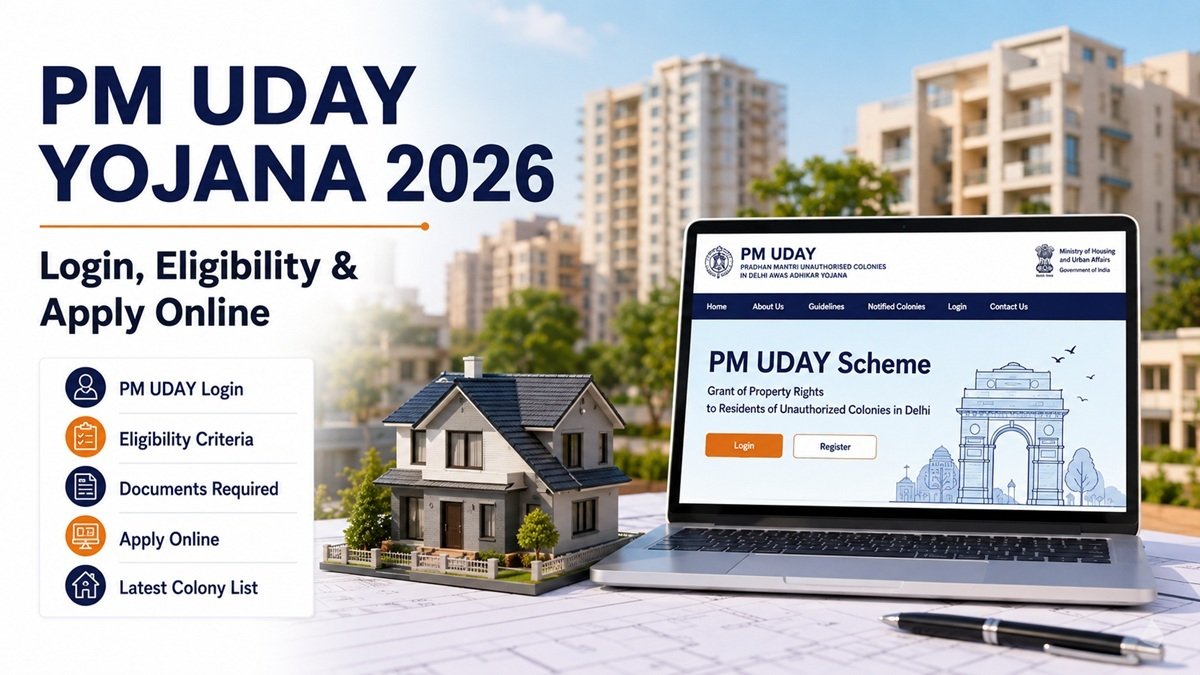
Millions of families in Delhi have lived for decades without legal ownership of their own homes. Many built houses in colonies that grew organically without formal government approval, leaving residents unable to sell, mortgage or transfer their property with confidence. The central government introduced PM UDAY to solve exactly this problem, and the scheme has picked up considerable momentum through 2026.
This guide explains what PM UDAY means, who qualifies, how the application process works and what has changed recently.
What Is PM UDAY Yojana
PM UDAY stands for Pradhan Mantri Unauthorised Colonies in Delhi Awas Adhikar Yojana. The Delhi Development Authority implements this initiative under the Ministry of Housing and Urban Affairs. It grants legal property rights to residents living in unauthorised colonies across the National Capital Territory of Delhi.
The government launched the PM UDAY scheme in 2019 following the enactment of the National Capital Territory of Delhi (Recognition of Property Rights of Residents in Unauthorized Colonies) Act. Before this law, residents held their property through documents such as General Power of Attorney, Will, or Agreement to Sell, none of which conferred proper legal title. These documents also could not be registered at the Sub-Registrar’s office, which left owners exposed and unable to access formal credit against their homes.
Today, the PM UDAY yojana covers 1,731 notified unauthorised colonies, home to an estimated 40 to 50 lakh residents.
Objectives Behind the PM UDAY Yojana
The government designed PM UDAY with several clear goals in mind.
- It aims to grant secure ownership, transfer and mortgage rights to residents who previously held no formal title.
- It seeks to improve access to banking and credit facilities by formalising property records, since banks generally will not lend against unregistered property.
- PM UDAY Scheme also supports planned urban development by bringing these colonies into a structured legal and infrastructural framework, including parks, roads and community facilities.
- Finally, the initiative promotes financial inclusion, allowing families to use their homes as collateral for loans and other financial products.
Key Features of PM UDAY Scheme
The PM UDAY scheme functions through a fully digital process, which sets it apart from older, paper-heavy regularisation drives.
Applicants submit everything through an online portal, and document verification also happens digitally. The scheme uses GIS-based mapping to verify plot boundaries and property details accurately, reducing disputes over land area. Once verification concludes, DDA issues either a Conveyance Deed or an Authorisation Slip, depending on the type of land involved. A Conveyance Deed typically applies to freehold land, while an Authorisation Slip covers leasehold or other categories.
DDA has set up ten processing centres and seventeen extended offices across Delhi, grouped by geographical proximity to the relevant colonies, so applicants do not need to travel far for scrutiny and verification.
Eligibility Criteria for PM UDAY Yojana
Not every property in Delhi qualifies automatically. To benefit from the PM UDAY yojana, the property must fall within one of the 1,731 notified unauthorised colonies. The applicant must be the actual resident or rightful occupant, generally holding documents such as a registered GPA, sale agreement, or possession letter as proof of continuous residence. The property should not fall under any exclusion category, such as land reserved for public projects, forest land, or areas near heritage sites and water bodies.
Residents should check the official colony list published by DDA to confirm whether their specific address is included, since boundaries and inclusions have been updated more than once since the scheme began.
Documents Required for PM UDAY Scheme
Applicants typically need proof of identity such as Aadhaar or a voter card, proof of address, ownership or possession documents like GPA, Will, or Agreement to Sell, property tax receipts if available, a recent photograph and a valid mobile number and email address for correspondence. Witnesses are also required later in the process, along with their photographs, since the final Conveyance Deed execution needs formal attestation.
How to Register: The PM UDAY Login Process
Applying under PM UDAY involves a structured, multi-step digital journey.
Applicants first visit the official PM UDAY portal and complete a PM UDAY login using their registered mobile number. The system sends a one-time password to that number, which the applicant enters along with a captcha code to proceed.
After logging in, the applicant fills in personal details, property details, email address and contact information in the application form. The next step involves uploading scanned copies of all required documents through the designated upload sections on the portal.
Applicants then need to arrange GIS mapping of their property through an empanelled documentation agency. Once the agency visits the site and uploads the geo-coordinates, the applicant enters the GIS ID on the portal and submits the application for scrutiny.
If DDA officials find any gaps during review, they issue a Deficiency Memo. Applicants can view this memo after another PM UDAY login, respond online and upload any additional documents needed to resolve it. Corrected applications go back for reassessment.
Once scrutiny concludes successfully, the portal generates a payment link, and applicants receive an SMS or email with a payment reference number. After payment, applicants log in again to enter witness details, book a time slot for document execution, and upload a notarised affidavit. The final Conveyance Deed or Authorisation Slip gets issued after document verification at the appointment.
Charges Applicable
Applicants pay nominal charges calculated according to property size and applicable circle rates. Charges differ for vacant plots compared with built-up properties, and DDA has published separate illustrative calculations for each category on its website. Those planning reconstruction or redevelopment should also note additional rules around Floor Area Ratio and road-width surrender requirements introduced in 2026.
Latest Updates on PM UDAY Scheme in 2026
The scheme has seen significant expansion this year. In April 2026, the Ministry of Housing and Urban Affairs announced that 1,511 out of the 1,731 unauthorised colonies would be regularised on an as-is, where-is basis, removing the earlier requirement for approved layout plans. This decision benefits an estimated 4.5 million residents and treats land use across these plots as officially residential.
Applications for regularisation under this expanded framework are being accepted through the MCD SWAGAM portal for cases where a Conveyance Deed or Authorisation Slip has already been issued under PM UDAY. Reports also indicate the government may extend the application deadline further, potentially to 31 October 2026, giving families who lacked documentation earlier more time to apply.
Reconstruction rules now require surrendering land equal to half of any road-width deficiency to achieve minimum access widths of six metres for internal roads and nine metres for approach roads. Floor Area Ratio calculations use the original plot size but apply within the reduced plot after any surrender, and penal charges apply where existing construction exceeds permissible limits.
Benefits for Residents
Legal ownership under PM UDAY brings tangible advantages. Owners gain the ability to sell, transfer or mortgage property through proper legal channels for the first time. Banks can now extend home loans against these properties, opening access to formal credit that was previously unavailable. Formal recognition also supports better civic infrastructure, since regularised colonies become eligible for planned roads, drainage and public amenities. Property values in these areas typically rise once legal title is secured, benefiting long-term residents financially.
Challenges Residents Should Know
The process is not without friction. Some residents report delays at the GIS mapping stage due to limited documentation agencies. Deficiency memos sometimes require repeated resubmission, which can extend timelines. Families still gathering historical possession documents may need extra time before they can complete their PM UDAY login and begin the application confidently. Staying updated through the official portal remains the most reliable way to track colony inclusion and deadline changes.
Understanding schemes like this matters when you are planning any property decision in Delhi. For deeper guides on ownership rights, home loans, documentation and everything else tied to Indian real estate, explore more expert articles on Zen Nest Living and make informed property choices with confidence. If you are facing trouble to get the complete understanding of this scheme or any other housing scheme, contact experts now.
Frequently Asked Questions
1. What is the full form of PM UDAY?
PM UDAY stands for Pradhan Mantri Unauthorised Colonies in Delhi Awas Adhikar Yojana, a scheme granting legal property rights to residents of unauthorised colonies in Delhi.
2. Who implements the PM UDAY scheme?
The Delhi Development Authority implements the scheme under the Ministry of Housing and Urban Affairs, following the National Capital Territory of Delhi (Recognition of Property Rights of Residents in Unauthorized Colonies) Act, 2019.
3. How do I complete PM UDAY login for the first time?
Visit the official portal, enter your registered mobile number, request an OTP, enter the OTP along with the captcha code, and proceed to fill in your application details.
4. What document do I receive after approval?
Successful applicants receive either a Conveyance Deed or an Authorisation Slip, depending on the land category, serving as legal proof of ownership or occupancy rights.