
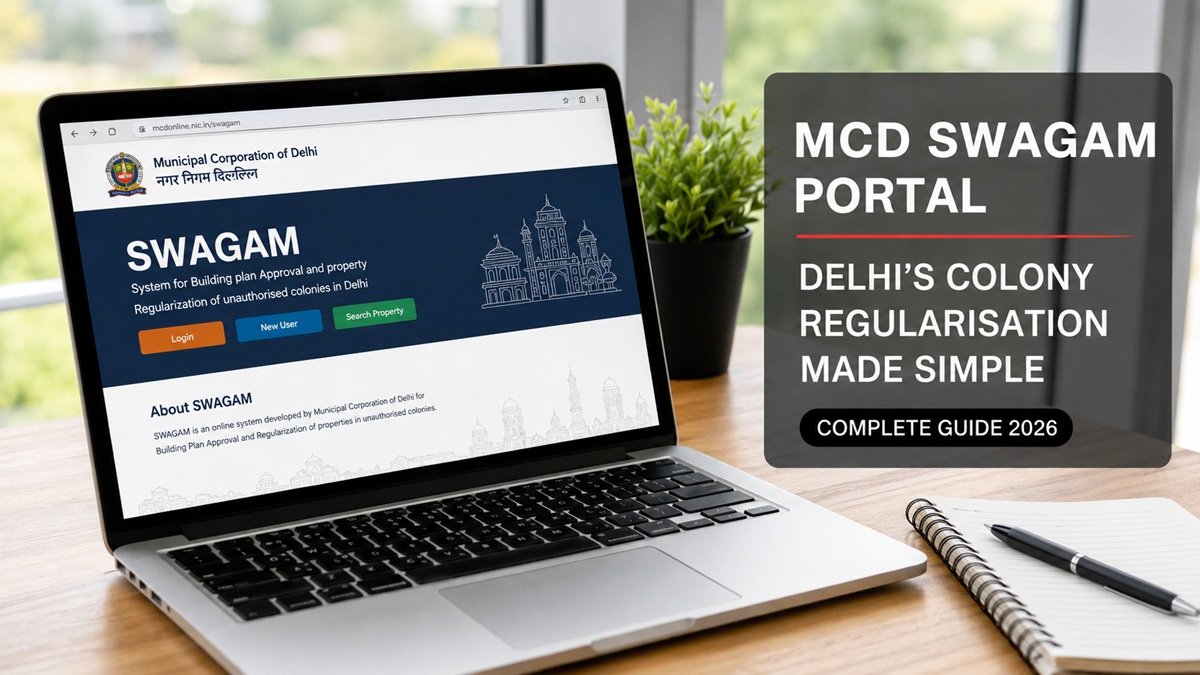
The Municipal Corporation of Delhi has rolled out a digital initiative to help residents of unauthorised colonies secure legal ownership of their homes. Known as the SWAGAM Portal and often searched as SWAYAM Portal on Google, this online system streamlines the regularisation process for more than 1,511 unauthorised colonies across the capital. If you live in Delhi and have wondered how to convert informal property papers into a recognised legal title, this guide walks you through everything the SWAGAM Portal offers, from eligibility to the step-by-step application process.
What Is the MCD SWAGAM Portal
The SWAGAM Portal or SWAYAM Portal is a digital platform built by the Municipal Corporation of Delhi to manage building plan approvals and property regularisation for unauthorised colonies. It works alongside two other government systems, namely the PM-UDAY portal run by the Delhi revenue department and the National Generic Document Registration System. Officials designed the interface to feel as simple as a banking application, so residents without technical knowledge can complete their applications without confusion. The name stands for the civic body’s attempt to bring transparency and speed to a process that previously involved years of paperwork and repeated visits to municipal offices.
Understanding PM-UDAY and Its Link with the SWAYAM Portal
The Pradhan Mantri Unauthorised Colonies in Delhi Awas Adhikar Yojana, commonly called PM-UDAY, began in 2019 to grant formal ownership rights to residents of unauthorised colonies. Many residents held only informal documents such as a General Power of Attorney, an Agreement to Sell, or basic possession papers. PM-UDAY converts these informal arrangements into a Conveyance Deed for properties standing on government land, or an Authorisation Slip for properties on private land. Once a resident receives either document, they become eligible to apply for further regularisation of their building structure. As of March 2026, roughly 40,000 Conveyance Deeds and Authorisation Slips had already been issued under the scheme.
When Did the MCD SWAGAM Portal Go Live
The MCD activated the portal on 24 April 2026, opening applications for residents who already hold a Conveyance Deed or Authorisation Slip. Before the public rollout, the system underwent demo testing to check its integration with government databases, and more than half of the drone surveys across the identified colonies were completed to map structures, road networks, and property boundaries. This survey data now feeds directly into the mapping system, forming the base record against which every application is checked.
Who Can Apply
In the initial phase, around 40,000 residents who had already secured ownership rights under PM-UDAY became eligible to apply directly. Residents who have not yet received their Conveyance Deed or Authorisation Slip need to first complete that stage through the PM-UDAY system before proceeding further. Applicants should also confirm that their property falls within one of the 1,511 identified unauthorised colonies before starting the process, since properties outside this list currently remain outside the scheme.
Step-by-Step Process to Apply at MCD SWAGAM Portal
Applying follows a clear sequence.
- First, visit the official website at mcdonline.nic.in/swagam and log in with your credentials.
- Second, select your unauthorised colony from the list of 1,511 eligible colonies, and the system automatically fills in your ward and zone.
- Third, indicate whether you already hold a PM-UDAY Case ID. If you do not have one, the system redirects you to complete that stage first.
- Fourth, once your Conveyance Deed or Authorisation Slip is issued, it gets transmitted to the MCD electronically, and your application form opens automatically.
- Fifth, engage an MCD-empanelled architect to prepare and upload the building plan of your existing structure, showing the actual number of floors and the layout on the ground.
- Sixth, the architect certifies these details, and once approved, the plan becomes part of your permanent property record along with the regularisation certificate.
Role of Empanelled Architects
The MCD has appointed more than 700 registered architects to assist applicants with documentation and building plan preparation. These professionals visit the property, record its existing condition, and upload accurate plans through the system. This step matters because regularisation happens on an as-is, where-is basis, meaning authorities accept the property exactly as it currently stands rather than waiting for a fresh layout plan to be drawn up. Residents planning reconstruction or redevelopment must surrender land equal to fifty per cent of any deficiency in the right of way, in order to meet minimum access standards of six metres for internal roads and nine metres for approach roads.
Documents You Will Need
Before applying, gather your Conveyance Deed or Authorisation Slip issued under PM-UDAY, proof of identity, proof of address, and any existing possession documents such as a General Power of Attorney or Agreement to Sell. Keep clear photographs of your property ready as well, since the architect will need these while preparing the building plan for submission. Applicants who lack a PM-UDAY Case ID should also keep basic ownership history and possession proof handy, as these get requested during the redirected PM-UDAY application stage.
How Long Does Approval Take
Officials estimate that the entire approval process, from submission to issuance of the regularisation certificate, takes between forty-five and sixty days. The digital system reduces the need for repeated physical verification in most cases, though some applications still require site visits when documentation is incomplete or when structural discrepancies appear on the ground.
Read More: YEIDA New Plot Scheme
Current Progress and Challenges
Uptake has been slower than authorities anticipated. Shortly after launch, only a small fraction of eligible residents had submitted applications, prompting the MCD to run awareness campaigns, including announcements on auto-tippers and information camps within colonies. Officials have also set up help desks at all twelve zonal offices to guide residents through the process. Early data showed a mix of approved, rejected, and pending applications, with delays traced to complex documentation requirements and the system’s dependence on the PM-UDAY database. Irregular layouts and existing violations of building norms have also made some cases technically difficult to clear. Despite these hurdles, the MCD continues pushing forward, aiming to process thousands of additional applications in the coming months.
Why This Matters for Property Owners
Regularisation unlocks several practical benefits for homeowners. Once a property carries a legal title, owners can apply for home loans, seek sanctioned building plans, and sell or transfer the property without the legal uncertainty that comes with informal documentation. For families who have lived for decades without proper paperwork, this represents a genuine shift towards secure, bankable property ownership. It also paves the way for the MCD to plan infrastructure upgrades, including roads, drainage, and civic amenities, once colonies achieve regularised status.
Anyone living in one of Delhi’s unauthorised colonies should treat this as a genuine opportunity rather than another bureaucratic exercise. Checking eligibility early, gathering documents in advance, and working closely with an empanelled architect can help residents move through the process without unnecessary delays.
Thinking about buying, selling, or regularising a property in Delhi? Zen Nest Living brings you clear, reliable real estate guidance to help you navigate ownership, documentation, and every step of your property journey with confidence. Explore more expert insights today. Contact us now for guidance and complete information.
Frequently Asked Questions
1. What is the SWAGAM Portal (SWAYAM Portal) used for?
The SWAGAM Portal is the Municipal Corporation of Delhi’s online system for regularising unauthorised colonies. It allows residents holding a Conveyance Deed or Authorisation Slip under PM-UDAY to submit building plans and apply for a formal regularisation certificate.
2. Who is eligible to apply?
Residents of the 1,511 identified unauthorised colonies who already hold a Conveyance Deed or Authorisation Slip under PM-UDAY can apply directly. Those without these documents must first complete the PM-UDAY process.
3. What documents do I need before applying?
You will need your Conveyance Deed or Authorisation Slip, proof of identity, proof of address, existing possession documents, and property photographs for the architect preparing your building plan.
4. How long does regularisation take once I apply?
Most applications take between forty-five and sixty days for approval, provided documentation is complete and no major site verification is required.