
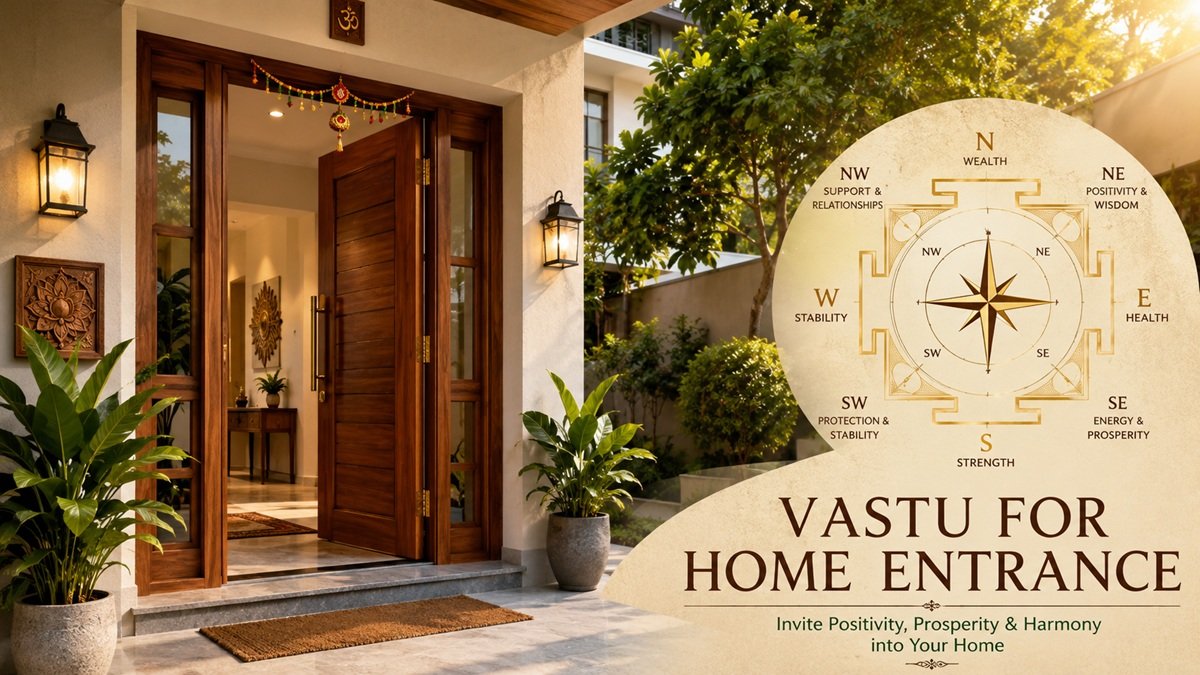
Your home entrance is far more than a gateway you pass through each day. According to ancient Indian architectural science, it is the point where energy first enters your living space, shaping the mood, health and fortune of everyone inside. Understanding Vastu for Home Entrance helps you design a doorway that welcomes positivity, prosperity and harmony into your household.
Whether you are constructing a new house, renovating an old one, or simply improving your current home, applying the principles of Vastu for Home Entrance can make a genuine difference. This guide covers everything you need, from checking the correct direction to practical tips you can apply today.
What Is Vastu for Home Entrance and Why Does It Matter
Vastu Shastra is a traditional Indian system of architecture that aligns buildings with natural forces such as the sun, wind and magnetic fields. The main door of your home acts as the primary channel through which cosmic energy, known as prana, flows inward. When you get Vastu for Home Entrance right, you allow this energy to circulate freely, supporting good health, financial stability and peaceful relationships within the household.
An incorrectly placed or poorly designed entrance can block or distort this flow, which practitioners believe leads to stagnation, stress and missed opportunities. This is why so many homeowners and architects across India, and increasingly abroad, take the direction and design of the main door seriously before finalising a floor plan. Before any construction or renovation work, it helps to spend time studying Vastu for Home Entrance in relation to your specific plot, since a generic rule rarely applies to every property in the same way.
Vastu Shastra for Home Entrance: Understanding the Directions
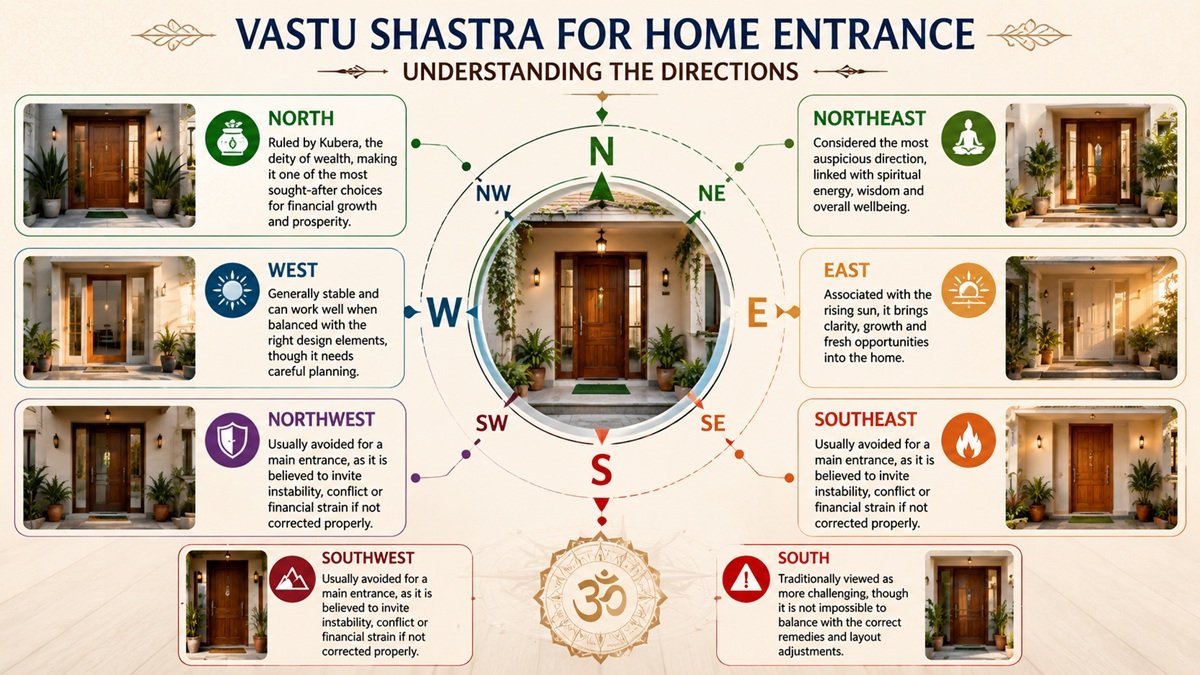
The foundation of Vastu Shastra for Home Entrance lies in the eight cardinal and intercardinal directions. Each direction carries a distinct energetic quality, and some are considered far more favourable for a main door than others.
North facing entrance: This direction is ruled by Kubera, the deity of wealth, making it one of the most sought-after choices for those who want to invite financial growth.
East facing entrance: Associated with the rising sun, an east-facing door is believed to bring clarity, growth and fresh opportunities into the home.
Northeast facing entrance: Considered the most auspicious direction in the entire discipline, the northeast corner is linked with spiritual energy, wisdom and overall wellbeing.
West facing entrance: A west-facing door is generally considered stable and can work well when balanced with the right design elements, though it needs careful planning.
South facing entrance: This direction is traditionally viewed as more challenging, though it is not impossible to balance with the correct remedies and layout adjustments.
Southeast, southwest and northwest: These directions are usually avoided for a main entrance, as they are believed to invite instability, conflict or financial strain if not corrected properly.
Read More: North East Facing House Vastu Tips and Complete Guide
How to Check Vastu for Home Entrance
If you want to know how to check Vastu for home entrance in your own house, you do not necessarily need to hire a consultant straight away. Here is a simple, step by step approach.
Step 1: Use a reliable compass. Stand at the centre of your home, known as the Brahmasthan, and use a magnetic compass or a compass app to determine the exact direction your main door faces.
Step 2: Divide the plot into a grid. Mark your home’s layout on a 9×9 grid, known as the Vastu Purusha Mandala, to pinpoint exactly which zone the entrance falls within.
Step 3: Identify the exact degree. Directions are further divided into sub-zones measured in degrees, so a door that appears to face north may sit within a less favourable sub-direction. Precision matters here.
Step 4: Assess the surrounding elements. Look at nearby staircases, toilets, kitchens or trees, as their placement relative to the entrance can influence the overall energy reading.
Step 5: Consult a professional if needed. For a detailed assessment, especially in irregularly shaped plots, it is worth consulting an experienced Vastu practitioner or architect familiar with modern building codes.
Learning how to check Vastu for home entrance properly ensures that any changes you make are based on an accurate reading rather than guesswork.
Best Entrance for Home as Per Vastu
When people ask about the best entrance for home as per Vastu, most experts point towards the northeast, north and east directions as the strongest options. These directions are associated with sunlight, positive energy flow and growth, which is why they remain the most recommended choices in both traditional homes and modern apartments.
That said, the best entrance for home as per Vastu also depends on the shape of your plot, the surrounding structures and the layout of interior spaces such as the staircase and kitchen. A skilled consultant will always look at the property as a whole rather than focusing on the door alone.
If you are buying a ready-built home rather than constructing one, do not worry if the entrance does not fall in the ideal direction. There are several design based corrections, discussed below, that can help balance the energy without any structural changes.
Practical Vastu Tips for Home Entrance
These vastu tips for home entrance are easy to implement and suit most homes, regardless of the direction your door faces.
Keep the entrance clutter free. Shoes, bins and unused furniture piled near the door restrict the smooth flow of energy. Keep this area tidy and well organised at all times.
Use a well maintained door. A door that creaks, sticks or has broken hinges is believed to disrupt positive energy. Ensure your main door opens and closes smoothly.
Add proper lighting. A bright, well lit entrance is considered one of the simplest and most effective vastu tips for home entrance, as it symbolically and literally welcomes light into the home.
Choose the right door colour. Earthy tones, browns, and light shades are generally favoured, while very dark colours are best avoided on the main door itself.
Place a threshold or Vastu symbol. Many households add a small threshold, a Swastika symbol, or an Om sign above or near the door to invite positive energy.
Avoid direct alignment with the back door. If your main door and back door align in a straight line, energy is believed to pass straight through the home without benefiting the occupants. Adding a partition or plant can help correct this.
Keep the number of doors odd. Traditional guidance suggests avoiding an even number of doors on a single wall, as odd numbers are considered more balanced.
Introduce plants thoughtfully. Fresh, healthy plants near the entrance are welcomed, though thorny plants such as cacti should be kept away from the main door.
Water features for balance. In certain directions, a small water feature near the entrance, when placed correctly, is thought to enhance prosperity, though this should always be checked against the specific direction of your home.
Applying these vastu tips for home entrance consistently, rather than as one off changes, tends to produce more noticeable results over time.
Common Mistakes to Avoid
Many homeowners unintentionally work against the principles of Vastu for Home Entrance by making a few common errors, and correcting them can noticeably improve the energy of the home.
- Placing a mirror directly facing the main door is one such mistake, as it is believed to reflect positive energy straight back outside.
- Similarly, an entrance that is significantly smaller or larger than the rest of the doors in the house can create imbalance.
- Overgrown trees or structures that block sunlight from reaching the doorway are also best avoided wherever possible.
Why This Matters for Modern Homes in 2026
As more buyers in 2026 look for homes that support both wellbeing and long term value, awareness around Vastu for Home Entrance continues to grow across metro cities and smaller towns alike. Builders and architects are increasingly incorporating these principles into modern floor plans from the design stage itself, rather than treating them as an afterthought. Whether you follow the discipline strictly or simply appreciate the practical logic behind concepts like natural light, ventilation and clutter free spaces, a thoughtfully designed entrance genuinely improves how a home feels to live in.
Final Thoughts
In summary, Vastu for Home Entrance combines practical design sense with time honoured tradition, giving you a clear framework to follow. Getting Vastu for Home Entrance right is not about rigid superstition. At its core, it draws on genuine architectural logic, encouraging good ventilation, natural light and a welcoming first impression. Whether you are house hunting, building from scratch or simply improving your existing doorway, these principles offer a practical and thoughtful framework worth considering.
If you are searching for a home that is thoughtfully designed with sound architectural and directional principles in mind, Zen Nest Living can help you find the right property. Contact us today to explore listings that blend modern comfort with time tested design wisdom.
Frequently Asked Questions
1. Which direction is considered the best for a home entrance according to Vastu?
The northeast, north and east directions are generally regarded as the most favourable, as they are associated with positive energy flow, growth and prosperity.
2. Can I correct a south facing or southwest facing entrance without rebuilding my home?
Yes. Simple remedies such as proper lighting, mirrors placed correctly, threshold designs and specific colours can help balance the energy without any structural changes.
3. Does the size of the main door matter in Vastu?
Yes, the main door is traditionally recommended to be the largest door in the house, as this is believed to allow a stronger flow of positive energy compared with smaller side doors.
4. Is it necessary to hire a professional consultant to check Vastu for Home Entrance?
While basic checks can be done at home with a compass and a grid layout, consulting a professional is recommended for irregular plots or before making any structural changes, to ensure accuracy.