
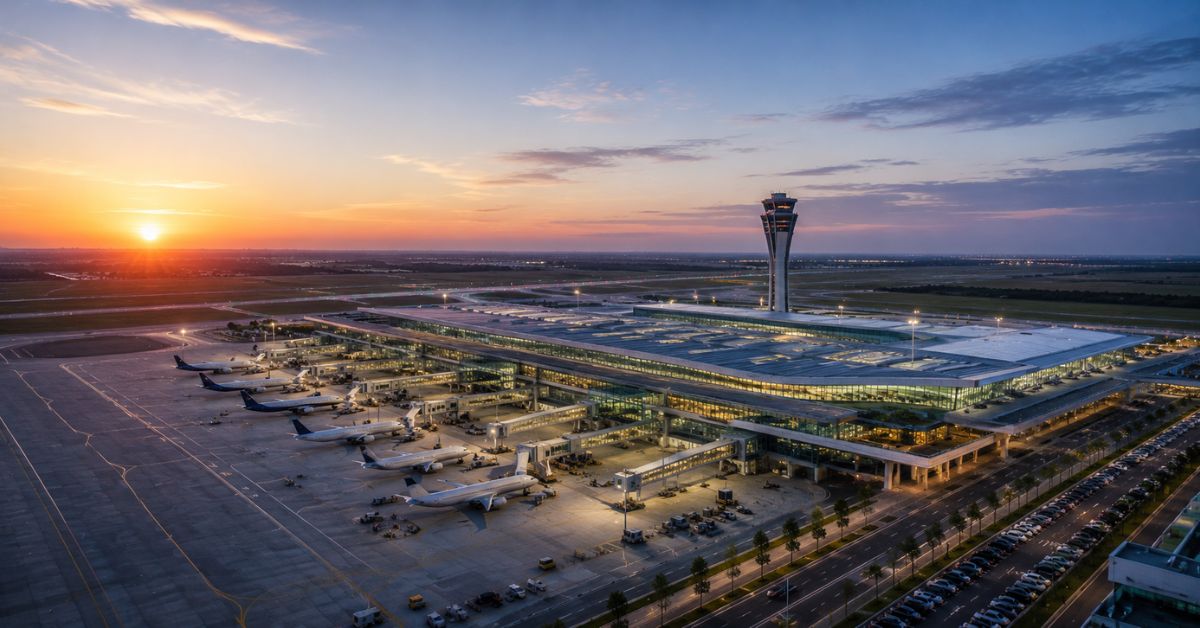
The date 15th June, 2026, was momentous for the National Capital Region. First flight from Jewar, Gautam Buddh Nagar took off from the airport. On this historic day, IndiGo flight 6E-2278 connected Lucknow, Noida and Bengaluru. The Noida International Airport first flight was used by the villagers who had handed over their ancestral land for this project. They were received by the Chief Minister Yogi Adityanath in Lucknow. It was a very emotional change to the families watching their farmland become a world-class airport. The foundation stone was laid on November 25, 2021 by Prime Minister Narendra Modi. On 28th March, 2026, he came back to inaugurate the 1st phase of the airport. That ceremony was the culmination of a vision on the visible plane. That dream came true with the first flight at the Noida International Airport just two months later.
For the real estate sector, this was not simply an aviation milestone. It was the starting signal for growth across Noida, Greater Noida, and the Yamuna Expressway corridor.
From Greenfield to Gateway
Noida International Airport is a 5000 hectares Greenfield Airport. It is located about 75 kilometres south of Delhi on the Yamuna Expressway. The total investment made in the project was around Rs 11,200 crore. It is intended to be a sustainable and future-proof infrastructure project, and will be a net-zero emissions facility. Yamuna International Airport Private Limited, a subsidiary of Zurich Airport International, operates the airport. Phase 1 comprises of one runway and one passenger terminal. In its current state, the facility will be able to accommodate 12 million passengers per year. Upon completion of all four development phases, the airport will cater to 70 million passengers per year.
The runway is CAT-III compliant, allowing flights to operate in low visibility, such as during dense winter fog, which is a frequent challenge for northern India. This certification makes the airport operationally superior for year-round schedules.
Cargo infrastructure adds significant economic weight to the project. A Multi-Modal Cargo Hub with an Integrated Cargo Terminal will handle over 2.5 lakh metric tonnes annually. This capacity is expandable to around 18 lakh metric tonnes. A dedicated 40-acre Maintenance, Repair and Overhaul facility has also been developed at the site.
Connecting the Region Through Air
The Noida International Airport first flight opened a domestic network that will grow rapidly. IndiGo became the airport’s first launch carrier. Starting June 15, daily flights connect Hyderabad, Noida, and Amritsar. Bengaluru-Noida-Jammu flights were added on June 16. By July, more places like Navi Mumbai, Srinagar, Jodhpur, and Dehradun will join the list. The airport will link 16 cities across 11 states by July 2026.
Residents across a wide geography gain direct value from this network. People in Noida, Greater Noida, Ghaziabad, Mathura, Aligarh, Agra, and Faridabad gain faster airport access and new opportunities. Travellers no longer need to cross Delhi to reach IGI Airport. The time saved and stress avoided represent a tangible quality-of-life improvement. Such improvements directly boost residential demand in surrounding areas.
Road and Metro Connectivity
Airport connections go beyond the airways. The Yamuna Expressway is a 165-kilometre road that runs from Greater Noida to Agra. Connects the airport with NCR’s prime urban areas through a six-lane toll access road with 1.5 km of tunnels. From the airport, it takes around 60-75 minutes to reach Delhi under normal traffic conditions. YEIDA is coordinating plans for metro and rail connectivity in the airport area with the Uttar Pradesh government. The Minister for Civil Aviation examined the connectivity plan which includes road, rail and metro connectivity and future high-speed rail connectivity. Delhi Metro Rail Corporation is in the process of planning a metro corridor that will connect Jewar to Greater Noida. The airport zone will be accessible to even more people as these multimodal links are being formed.
Property Prices Near Jewar International Airport
Previously, the property prices in the vicinity of the airport spiked even before the first flight of the Noida International Airport. According to the Square Yards report “Runway to Realty”, there has been tremendous appreciation in the property value in the Yamuna Expressway corridor from 2020-25. The apartment price increased by 158 per cent from Rs 3,950 per square foot in 2020 to Rs 10,200 per square foot in 2025 while the YOY growth was at 7.37 per cent. The values of plots in some micro-markets saw as much as 536 per cent appreciation in six years. This indicates a CAGR of 30-35 percent during this period.
Now there are two phases of price movement driven by the airport, experts differentiate between them. The first is the announcement effect, when people start speculating buying because the project is confirmed. The phase is now over. The second is the operational effect, which is the response of prices to the actual level of economic activity. Business analysts expect the property values near the airport to increase between 15 and 20 per cent in four to five years. Plots are likely to appreciate by around 20 per cent, apartments by around 25 per cent and annual appreciation is expected to be 12-18 per cent in the future.
The airport influence zone covers more than 20,000 sq. km and affects 40-50 million people and the area is rapidly transforming into an infrastructure driven real estate growth area. Growth in jobs, demand for logistics and continued business investment will now drive price appreciation. But it will no longer be sentiment alone that will be the determining factor.
Housing Demand: Structural, Not Speculative
The Noida International Airport first flight triggers housing demand that goes beyond investor activity. Large airports create deep and sustained demand for workforce housing. Aviation staff, cargo handlers, hospitality workers, logistics employees, and retail workers all need homes near their workplaces. This need grows as passenger volumes and cargo traffic increase over time.
The inauguration of Noida International Airport marked a key inflection point for the Yamuna Expressway corridor, with residential queries rising 56 percent and commercial demand rising 75 percent shortly after the announcement. Buyers and businesses were making real decisions months before flights began.
In January 2026, YEIDA launched a residential plot scheme offering 973 plots across multiple sectors, ranging from 162 to 290 square metres, positioned to attract buyers ahead of the airport’s operationalisation. The scheme attracted both end-users and investors seeking an early entry point into the corridor.
High-impact micro-markets including YEIDA Sectors 18, 20, 22D, 32, Sector 150, Greater Noida West, and Delta-Zeta zones are gaining traction, driven by enhanced connectivity, expressways, and infrastructure upgrades.
The broader development ecosystem adds further depth to this demand. YEIDA’s Sector 10 Electronics Hub is emerging as an employment anchor. Construction has been completed on 52 plots, 27 units have started production, and around 340 more units are under construction. YEIDA is aiming to produce around 180 units by the end of 2026. Each new business creates jobs. Each job generates demand for housing and retail nearby. The proposed Film City near Jewar adds yet another buyer segment. A Bollywood production is already shooting at the site. Once operational, Film City will attract creative professionals, technicians, and support businesses, adding a new category of housing demand along the corridor.
Office Markets: Noida Rising
The Noida International Airport first flight also gives a new direction to the commercial real estate story in the city. Once considered as the affordable choice compared to Gurugram, Noida’s office market is now seeing a surge in activity. That framing is outmoded. Noida is in a different league as it is connected to international airports.
According to Colliers India, the annual office leasing in Noida could hit 2-3 million square feet, or almost a quarter of the entire absorption of Grade A office space in Delhi-NCR from 2026 onwards. That’s a big slice of the market which was once thought of as a secondary market.
The institutional-grade supply is projected to rule the roost by 2028 with nearly 2.9 million square feet, indicating a quality-maturation cycle, while strata-led completions are expected to exceed 2.5 million square feet in 2026. The Yamuna Expressway belt is already fetching a 15 to 35 per cent premium over valuations in 2024. The 1.65 lakh square foot leasing agreement by Accenture confirms the appetite of the big international companies for this corridor. The rental yields of high-end commercial properties in Noida range between 8 to 12 percent. Well positioned office assets will see 15-20 percent capital appreciation per year.
With the proposed Singapore-style city near Jewar Airport that will be similar to Aerocity in Delhi, Noida’s real estate sector is getting a strategic boost in North India. This is another sign of a structural change, similar to what Aerocity did in Delhi, where Noida is becoming a property and business hub for global occupiers, adding to the office market value.
What This Means for Buyers and Investors
The Noida International Airport first flight marks the transition from promise to performance for the entire region. The market is shifting from speculative momentum to fundamentals-led growth, driven by industrial activity, logistics demand, and job creation that strengthen absorption, rental yields, and liquidity.
India’s aviation sector is on a strong growth trajectory. Western Uttar Pradesh is already drawing semiconductor firms, EV manufacturers, and data centre operators. The Noida International Airport first flight adds world-class aviation infrastructure to this mix. Together, these forces create one of India’s most compelling real estate stories of this decade.
Residential buyers should prioritise YEIDA-approved projects with access to major expressways and planned metro corridors. End-users and investors alike will find the Yamuna Expressway corridor compelling through 2030 and well beyond. Commercial investors should note Noida’s improving risk-reward profile. The city offers better entry prices than Gurugram and stronger appreciation prospects than markets that have already peaked. The transition to institutional-grade office stock from 2027 further strengthens the long-term case.
The Noida International Airport is built at a scale that matches India’s ambitions. Its first flight was not an ending. It was the beginning of a new chapter for one of the country’s most dynamic development corridors.
Frequently Asked Questions
When did the Noida International Airport first flight take off?
The Noida International Airport first flight commenced on June 15, 2026. IndiGo operated the inaugural service as Flight 6E-2278. The flight arrived from Lucknow and departed onward to Bengaluru. PM Modi had inaugurated Phase 1 of the airport on March 28, 2026, with commercial operations beginning shortly thereafter.
How much have property prices risen near Noida International Airport?
Apartment prices along the Yamuna Expressway rose 158 percent between 2020 and 2025, moving from Rs 3,950 to Rs 10,200 per square foot. Plot values in select micro-markets appreciated by up to 536 percent over six years. Analysts now project an additional 20 to 25 percent upside across the 2026 to 2027 period.
Which areas near Jewar Airport offer the best real estate investment opportunity?
The strongest investment micro-markets include YEIDA Sectors 18, 20, 22D, and 32. Sector 150, Greater Noida West, and the Delta-Zeta zones are also high-impact areas. These sectors benefit from expressway connectivity, growing employment clusters, and direct proximity to the airport development corridor.
How will the Noida International Airport impact the office market in NCR?
Colliers India estimates Noida’s annual office leasing could reach 2 to 3 million square feet going forward. This would represent nearly one-fourth of Delhi-NCR’s Grade A office space absorption. International airport connectivity makes Noida far more competitive for global companies and technology firms. Commercial rental yields in well-positioned areas currently average between 8 and 12 percent.
