
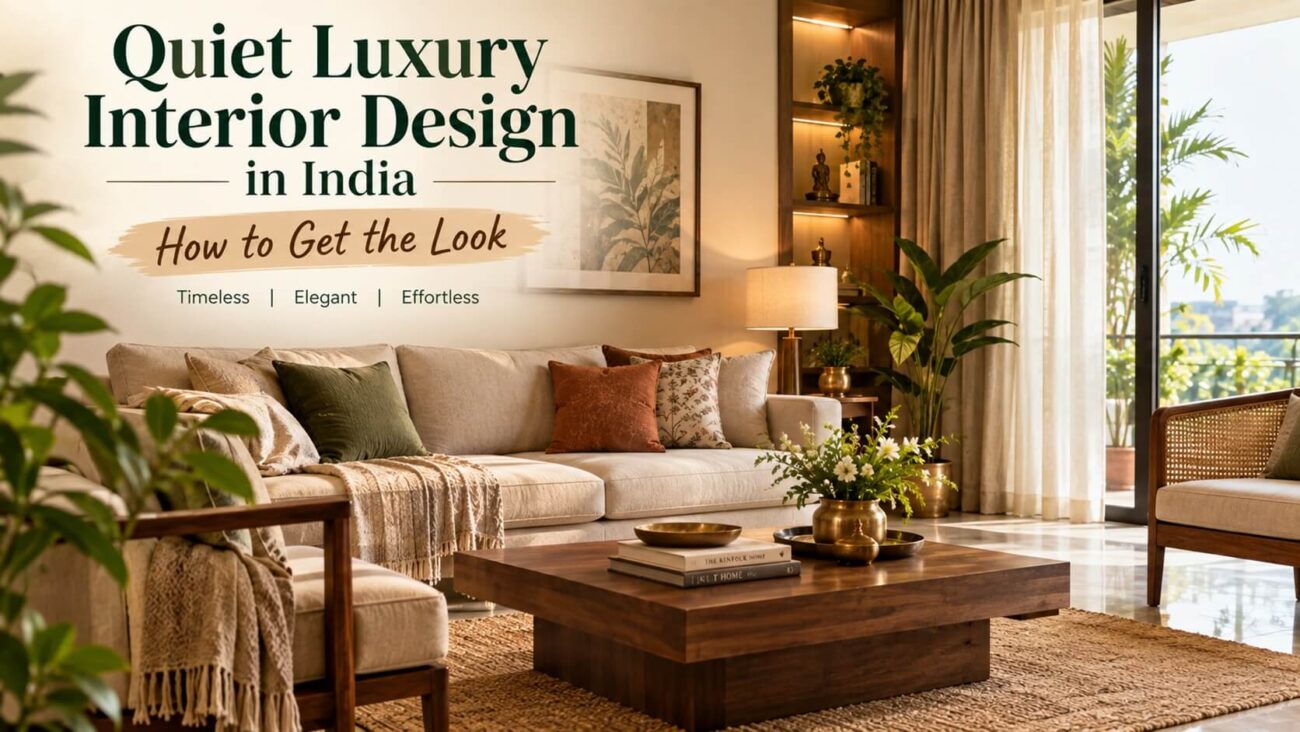
Walk into a truly elegant home and you rarely spot a logo. You notice calm instead. The light feels soft. The sofa invites you in. Nothing shouts for attention.
That feeling sits at the heart of quiet luxury interior design. It swaps flash for finish and trends for timelessness.
In India, the look needs a thoughtful twist. Our homes handle festivals, joint families, monsoon humidity, and plenty of dust. A cold, minimal copy from a Milan catalogue will not survive one Diwali week.
This guide shows how to build quiet luxury interior design around Indian habits, budgets, and climates. You will find a palette chart, a materials table, room by room advice, and a simple budget split.
What Is Quiet Luxury Interior Design?
Quiet luxury interior design is a style built on restraint. It values quality over display. Every object earns its place through craft, texture, or comfort.
Think of it as the opposite of a showroom. Nobody should guess the price of your sofa at a glance. They should simply want to sit down and stay.
Five ideas hold the style together:
- Layered neutral colours instead of loud contrasts
- Natural materials that feel good to touch
- Fewer pieces, chosen with care
- Warm, low lighting at several heights
- Craft and workmanship over visible branding
Here is how it differs from the louder style many of us grew up seeing.
| Element | Loud luxury | Quiet luxury |
|---|---|---|
| Colour | Bold golds, high contrast | Soft neutrals, tonal layers |
| Furniture | Heavy carved sets | Clean lines, solid wood |
| Lighting | One big chandelier | Layered warm lamps |
| Decor | Many showpieces | A few handmade pieces |
| Branding | Visible labels | No visible logos |
| Finish | High gloss | Matte, satin, textured |
Why Quiet Luxury Suits Indian Homes
India already has a quiet luxury tradition. Picture a handloom Chanderi curtain, a Kota stone floor, or a brass urli resting in a corner. Old havelis relied on proportion, stone, and shade rather than clutter.
So quiet luxury interior design in India does not mean importing a foreign look. It means editing what we already love. Remove the excess. Keep the craft.
Vastu followers will find good news here too. Open space, natural light, and clean corners already match many Vastu principles. A calm home often scores well on both counts.
The Three Touch Rule: A Simple Test Before You Buy
Here is a trick worth trying when you plan a room. Every space needs three textures you want to touch. One soft, one cool, and one warm.
Soft could be a linen cushion or a woollen throw. Cool could be a Kota stone tabletop. Warm could be a teak shelf or a brass lamp base.
If a room lacks one of these three, it feels flat, however expensive it looks. If it has all three, even a simple room feels rich.
Apply this rule to every room. It works better than any mood board, because quiet luxury interior design is felt through the hands first and the eyes second.
Build a Calm Colour Palette
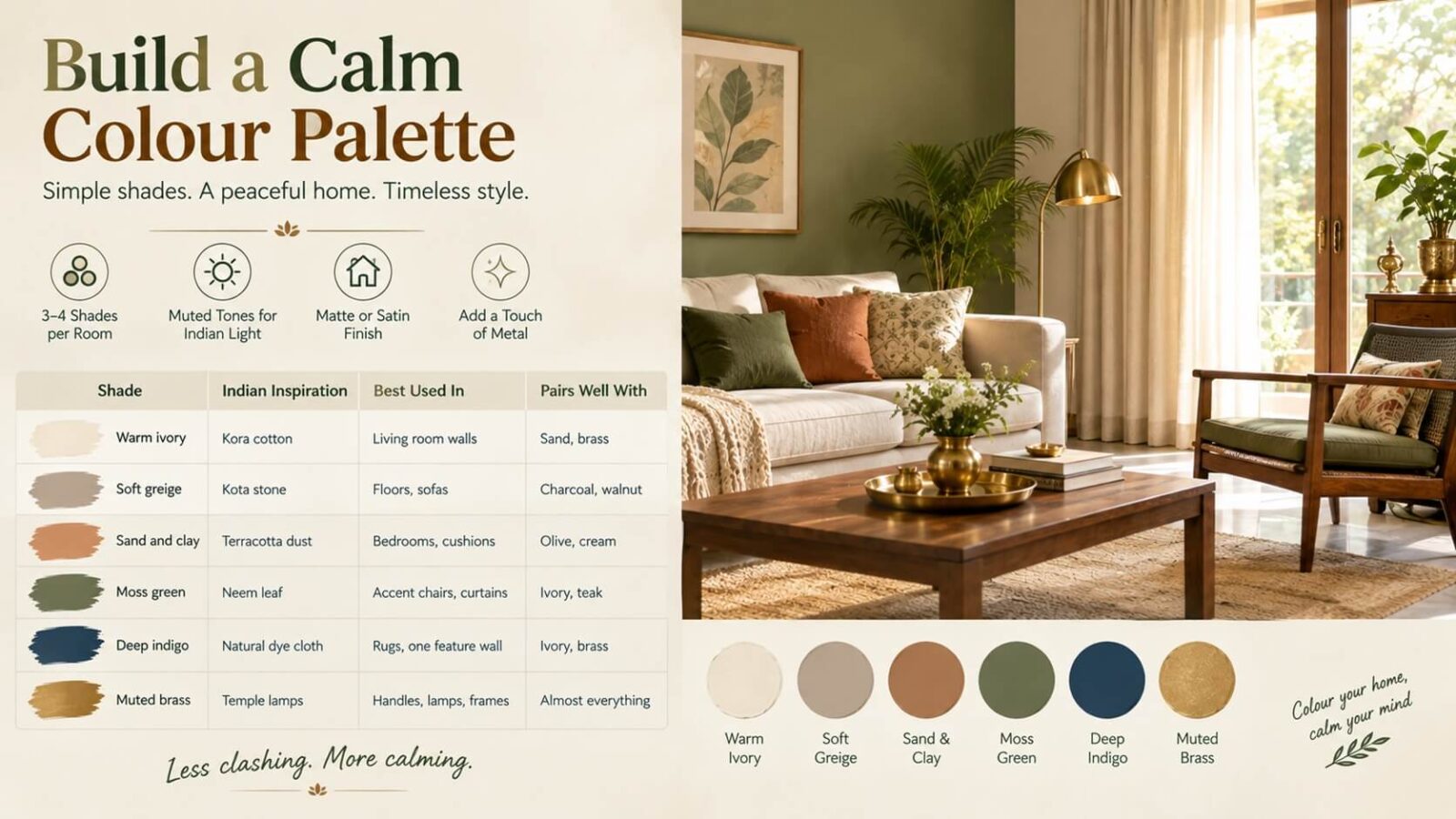
Stay within three or four shades per room. Pick one base, one supporting tone, and one deep accent. Add a soft metal for sparkle.
Indian light is strong and warm, so choose slightly muted tones. Pure white can glare at noon. Cream, ivory, and soft greige read calmer.
| Shade | Indian inspiration | Best used in | Pairs well with |
|---|---|---|---|
| Warm ivory | Kora cotton | Living room walls | Sand, brass |
| Soft greige | Kota stone | Floors, sofas | Charcoal, walnut |
| Sand and clay | Terracotta dust | Bedrooms, cushions | Olive, cream |
| Moss green | Neem leaf | Accent chairs, curtains | Ivory, teak |
| Deep indigo | Natural dye cloth | Rugs, one feature wall | Ivory, brass |
| Muted brass | Temple lamps | Handles, lamps, frames | Almost everything |
Keep the finish matte or satin. Glossy paint shows every fingerprint and bounces glare around. Lime wash or textured plaster adds depth without any pattern.
Read More: Silver Home Decor Trend
Choose Materials That Age Well
Quiet luxury interior design depends on materials more than any other element. Cheap finishes cannot hide in a quiet room. Everything stays visible.
Climate matters too. Humidity swells some woods. Dust clings to certain fabrics. Choose with your city in mind.
| Material | Where to use it | Indian climate note |
|---|---|---|
| Kota stone | Floors, counters, tabletops | Handles heat and heavy foot traffic well |
| Solid teak or sheesham | Beds, consoles, dining tables | Stays stable in humidity when well seasoned |
| Cane and jute | Chairs, rugs, pendant shades | Breathes well, but keep away from rain splash |
| Handloom cotton and linen | Curtains, cushions, throws | Wash gently, as sun fades dark dyes |
| Brass and bronze | Handles, lamps, decor | Develops patina, so polish only when needed |
| Lime plaster | Walls, ceilings | Breathable, so it suits damp coastal homes |
| Honed marble | Feature walls, bathrooms | Stains easily, so seal it every year |
Skip high gloss laminates and faux marble prints. Fake finishes break the mood fast.
Get the Lighting Right
Lighting makes or breaks this look. Most Indian homes rely on one bright ceiling light. That flattens everything in the room.
Try this layered plan instead:
- Use warm bulbs between 2700K and 3000K
- Add cove lighting along the ceiling edge
- Place table lamps at sofa and bedside level
- Install dimmers in living and bedroom areas
- Use one spotlight for a single art piece
Avoid cool white tubes in living areas. They make rich fabrics look dull. Evening light should feel like a glow, not a hospital corridor.
Good lighting is the cheapest upgrade in quiet luxury interior design. A few lamps can change a room within an hour.
Furniture: Fewer Pieces, Better Lines
Choose furniture with clean lines and soft edges. Low sofas, rounded coffee tables, and slim wooden legs work well. Avoid heavy carving and shiny tufting.
Buy the sofa first and spend the most on it. Pick oatmeal, stone, or taupe. Choose removable covers, because children, chai, and turmeric exist.
Leave breathing space around each piece. Empty floor is a real luxury in Indian cities. Do not fill every wall and corner.
Curtains and Soft Furnishings
Curtains deserve special attention. Floor length drapes in linen or cotton blend add height and softness. Mount the rod close to the ceiling.
Use two layers. Sheers handle daylight, and heavier drapes give privacy. Strong summer sun fades colour, so pick lined fabrics.
Cushions need restraint too. Use three to five per sofa in solid or tone on tone textures. Add one handblock print for charm.
Room by Room: Where to Start
Living Room
Anchor the room with one large sofa and two accent chairs. Add a woven jute rug under the seating. Keep the TV unit simple, with closed storage below.
Hide wires and remotes. Visible clutter ruins quiet luxury interior design faster than a wrong colour.
Bedroom
Use layered bedding in cotton, linen, and a wool throw. Stick to two or three tones. Place matching lamps on both sides of the bed.
Fit a fluted wooden headboard or a simple upholstered one. Skip mirrored wardrobes and busy wallpapers. Calm sleep needs calm walls.
Kitchen and Dining
Matte cabinets in sand or sage look refined. Choose handleless shutters or slim brass pulls. Honed stone counters hide small marks.
Keep the dining table in solid wood. Add six chairs in cane or linen. Serve food in ceramic and brass, not plastic.
Pooja Room
Many Indian homes have a pooja space. Treat it with the same restraint. Use a wooden or marble mandir, a small brass bell, and warm light.
Place it in the northeast, as Vastu suggests, if the layout allows. Avoid neon lights and plastic garlands. A simple diya often looks best.
Balcony
Make it a small retreat. Add two cane chairs, a stone side table, and a few potted plants. Areca palm and snake plant cope well with Indian heat.
Declutter Without Losing Your Culture
Indian homes store a lot. Steel utensils, festival decor, guest bedding, and family heirlooms all need space. Quiet luxury interior design does not ask you to throw these away.
It asks you to hide them well. Use floor to ceiling wardrobes with flat or fluted shutters. Add a storage bench in the entry. Keep only a few treasured items on display.
Rotate decor with the seasons. Display Diwali brass in October and store it in November. A short shelf feels richer than a crowded one.
Art and Accents With Purpose
Choose one large artwork over many small frames. Handwoven textiles, Khurja pottery, Dhokra figures, and Pattachitra pieces suit this style beautifully.
Buy from craft fairs, cooperatives, or directly from artisans. You get a story, and the artisan earns a fair price. This human detail adds a richness no brand can match.
Place accents in odd numbers. Three vases look better than two. Leave one shelf empty on purpose.
A Quick Makeover Example
Picture a 1,100 square foot 2BHK flat with a crowded living room. The walls are bright yellow, the sofa is patterned, and shelves hold forty showpieces.
Repaint the walls in warm ivory. Swap the sofa cover for oatmeal linen. Remove thirty showpieces. Add two lamps and one jute rug.
The room gains calm without a single large purchase. That is the real power of editing.
A Realistic Budget Plan
You do not need a villa budget. Quiet luxury interior design rewards smart spending, not big spending. Splurge where you touch, and save where you do not.
| Priority | Suggested share of budget | Why it matters |
|---|---|---|
| Sofa and main seating | 25 percent | You use it every day |
| Flooring and wall finish | 20 percent | Sets the base tone |
| Lighting | 15 percent | Changes the mood fastest |
| Curtains and rugs | 15 percent | Adds softness and layers |
| Storage and carpentry | 15 percent | Keeps clutter out of sight |
| Art and accents | 10 percent | Adds personality |
These shares are a starting guide, not a rule. Adjust them to your home and city.
Save on side tables, planters, and bedside lamps. Good local carpenters can build clean, simple pieces at fair rates.
Care and Maintenance in Indian Conditions
Quiet luxury interior design only works when your home looks fresh. Dust and humidity test it every season. Plan upkeep from day one.
- Dust furniture weekly with a microfibre cloth
- Vacuum rugs twice a week in dry, dusty cities
- Place silica gel packs in wardrobes during monsoon
- Keep teak furniture away from AC drip and damp walls
- Wipe brass and stone with a dry cloth, since hard water leaves marks
- Rotate cushions and rugs every few months to avoid uneven fading
Common Mistakes to Avoid
- Using too many colours in one room
- Buying matching furniture sets
- Choosing glossy finishes
- Ignoring curtains and lighting
- Following trends without checking comfort
- Displaying every souvenir you own
Matching sets look stiff and dated. Mix wood tones and textures instead. A room should look collected over time, not ordered in one go.
A Simple Weekend Plan to Begin
You can start small. Try this plan over one weekend.
- Saturday morning: clear surfaces and donate extras
- Saturday afternoon: swap bulbs for warm ones and add two lamps
- Sunday morning: replace patterned cushions with solid linen ones
- Sunday afternoon: add one rug, one plant, and one handmade piece
Live with the changes for a week. Then decide what to add. Quiet luxury interior design grows slowly, and that is the point.
Final Thoughts
Quiet luxury interior design is not about spending more. It is about choosing better and stopping sooner.
Start with light, texture, and a calm palette. Add craft from Indian artisans. Let each piece breathe.
The best quiet luxury interior design feels personal, not staged. Your home should smell of fresh flowers or chai, not of a showroom. Keep that warmth, and the luxury follows.
Pick one room this week and try the Three Touch Rule. You may be surprised how fast it changes the space.
Frequently Asked Questions
1. What is quiet luxury interior design?
Quiet luxury interior design is a restrained style that focuses on quality, texture, and comfort. It uses neutral colours, natural materials, and minimal decor. Nothing relies on visible branding to look rich.
2. Is quiet luxury expensive to achieve in India?
Not necessarily. Spend on lighting, seating, and flooring, and save on accessories. Local carpenters, craft fairs, and handloom markets offer excellent value.
3. Which colours work best for this style in Indian homes?
Warm ivory, greige, sand, moss green, and deep indigo work well. Indian sunlight is strong, so choose matte, slightly muted shades.
4. Does quiet luxury interior design work in small flats?
Yes. The style suits small spaces because it favours fewer pieces, light colours, and closed storage. Mirrors and layered lighting add depth without clutter.
