
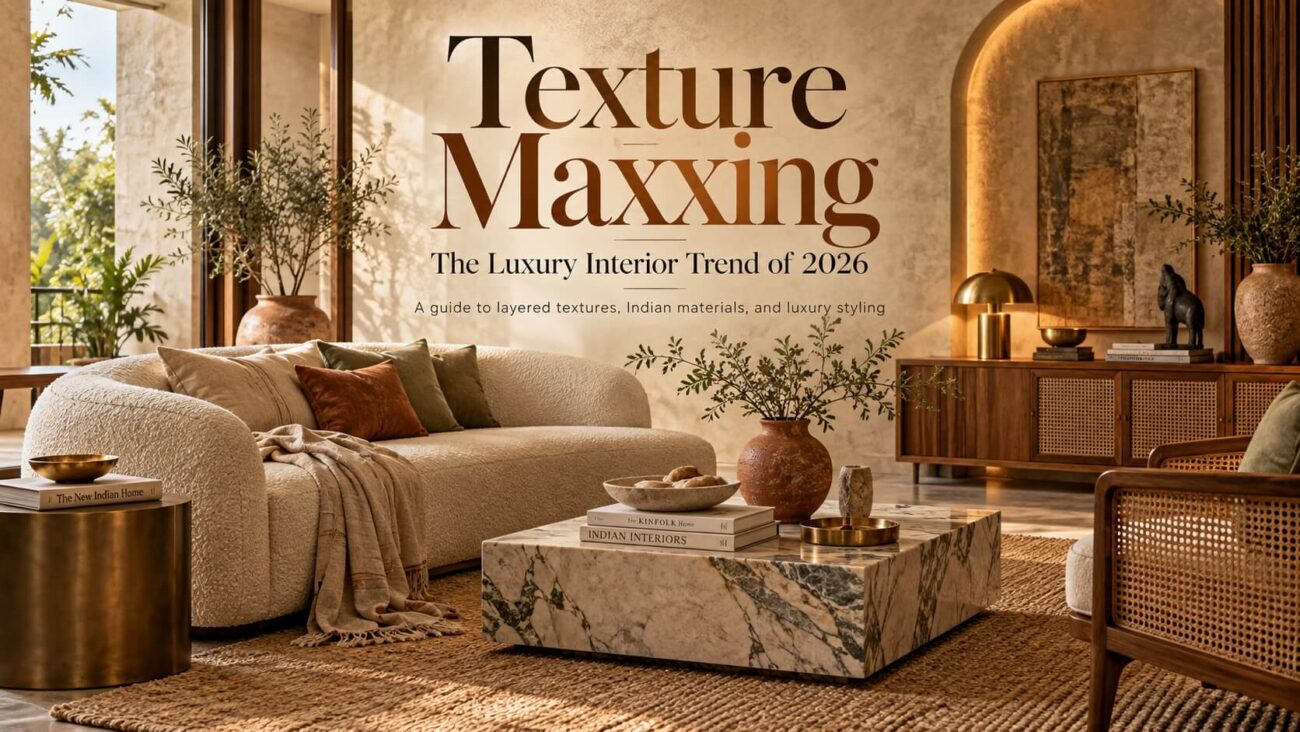
Walk into a luxury home in 2026 and your hands start exploring before your eyes finish. Walls feel soft and chalky. Sofas feel nubby. Wooden tables show their grain. Stone feels cool and honed.
That layered, touch-first style has a name. Designers call it Texture Maxxing.
This guide explains what Texture Maxxing means and why wealthy homeowners love it. You will learn how to try it in an Indian home. Expect a layering rule, climate advice, a budget plan, and a checklist.
What Is Texture Maxxing?
Texture Maxxing means layering many tactile surfaces in one room, on purpose. The goal is depth, not decoration.
A room feels rich when surfaces contrast. Think of rough jute under a smooth marble table. Picture nubby bouclé beside glossy lacquer. Each surface makes its neighbour look better.
The word “maxxing” comes from internet slang. It means pushing something to its limit.
Texture Maxxing is not the same as maximalism. Maximalism piles on colour, pattern, and objects. This trend piles on feel, often inside a calm colour palette.
Why Luxury Homes Love Texture Maxxing in 2026
Several shifts explain the rise of this style.
- People spend hours on flat screens, so they crave real sensations at home.
- All-white minimal rooms started to feel cold and impersonal.
- Neutral palettes dominate luxury interiors, so texture now adds the interest colour once did.
- Buyers value craft and handmade finishes more than visible brand logos.
- Close-up photos on social media reward rich surface detail.
Quiet luxury also plays a big role. Texture Maxxing delivers richness without shouting. A hand-troweled wall says more than a gold-framed mirror.
Read More: Curved Furniture Trend 2026
The Five Texture Families
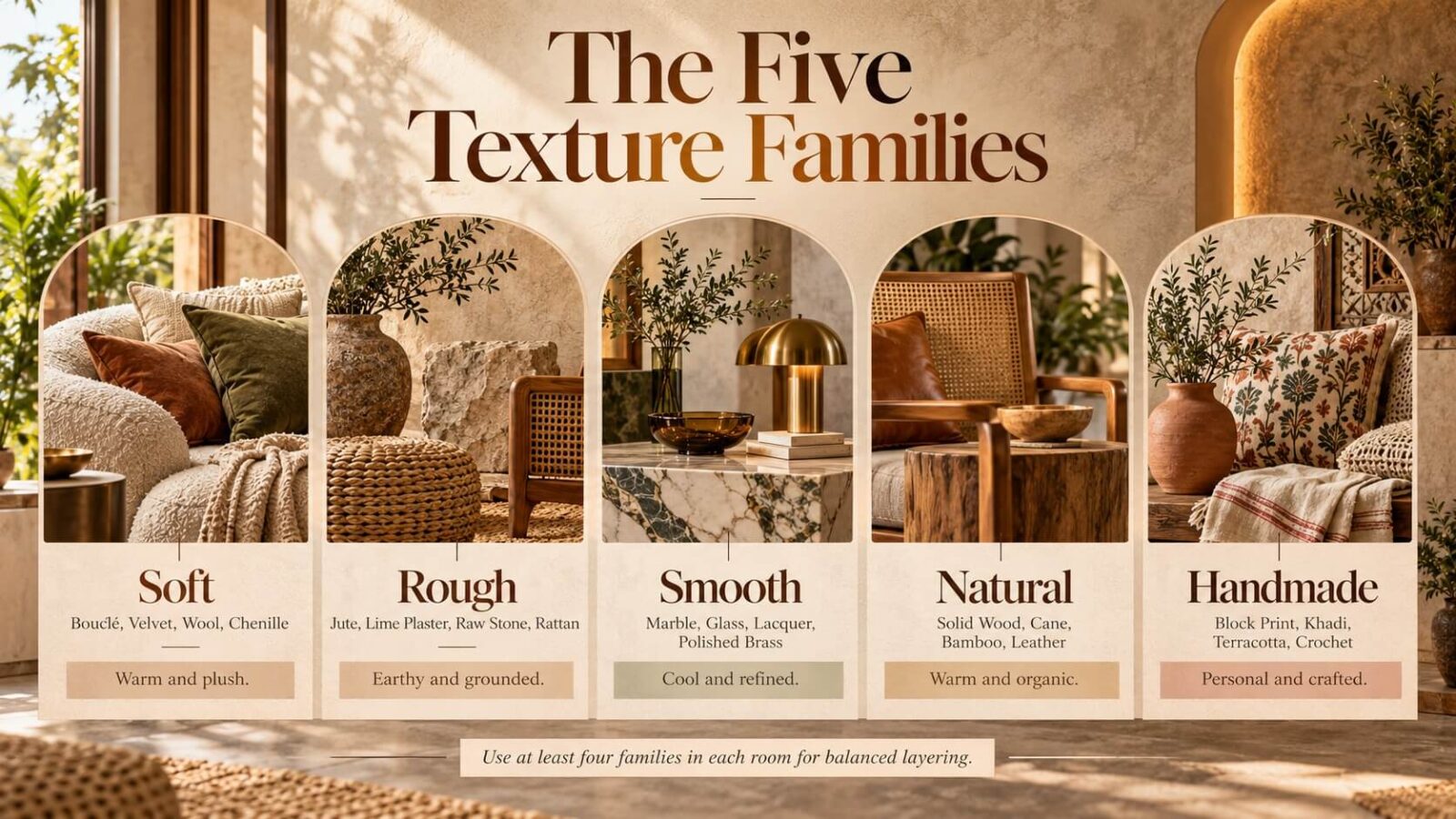
Every layered room draws from five families. Use at least four in each room.
| Family | Examples | Feels like | Best used in |
|---|---|---|---|
| Soft | Bouclé, velvet, wool, chenille | Warm and plush | Sofas, cushions, throws |
| Rough | Jute, lime plaster, raw stone, rattan | Earthy and grounded | Rugs, walls, planters |
| Smooth | Marble, glass, lacquer, polished brass | Cool and refined | Tabletops, lamps, mirrors |
| Natural | Solid wood, cane, bamboo, leather | Warm and organic | Furniture, pendants, chairs |
| Handmade | Block print, khadi, terracotta, crochet | Personal and crafted | Cushions, curtains, decor |
No single family should dominate. A room of only soft items feels sleepy. A room of only smooth items feels like a showroom.
The 60-30-10 Texture Rule
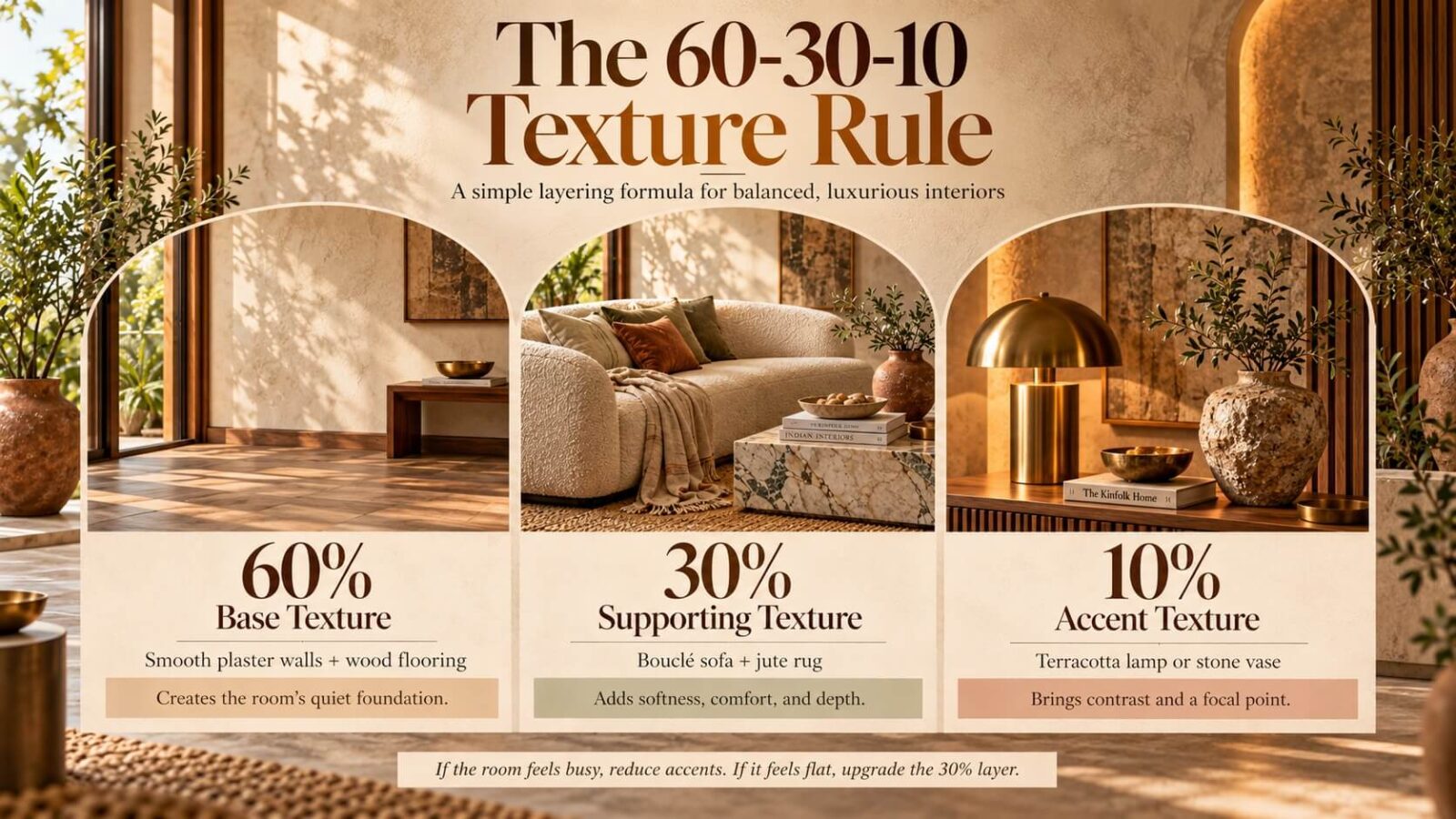
Designers use the 60-30-10 rule for colour. We suggest applying it to texture as well. It stops a room from turning chaotic.
- 60 percent: One calm base texture, such as smooth plaster walls and wooden flooring.
- 30 percent: A supporting texture, such as a linen sofa and a woollen rug.
- 10 percent: A bold accent, such as a rough stone vase or a shaggy cushion.
Picture a 3BHK living room in Noida. Smooth cream walls form the base. A bouclé sofa and jute rug add the second layer. One chunky terracotta lamp provides the surprise.
Use the same ratio when you edit. If the room feels busy, remove accents first. If it feels flat, upgrade the 30 percent layer.
Read More: Best Indoor Plants for Home
Room by Room Guide
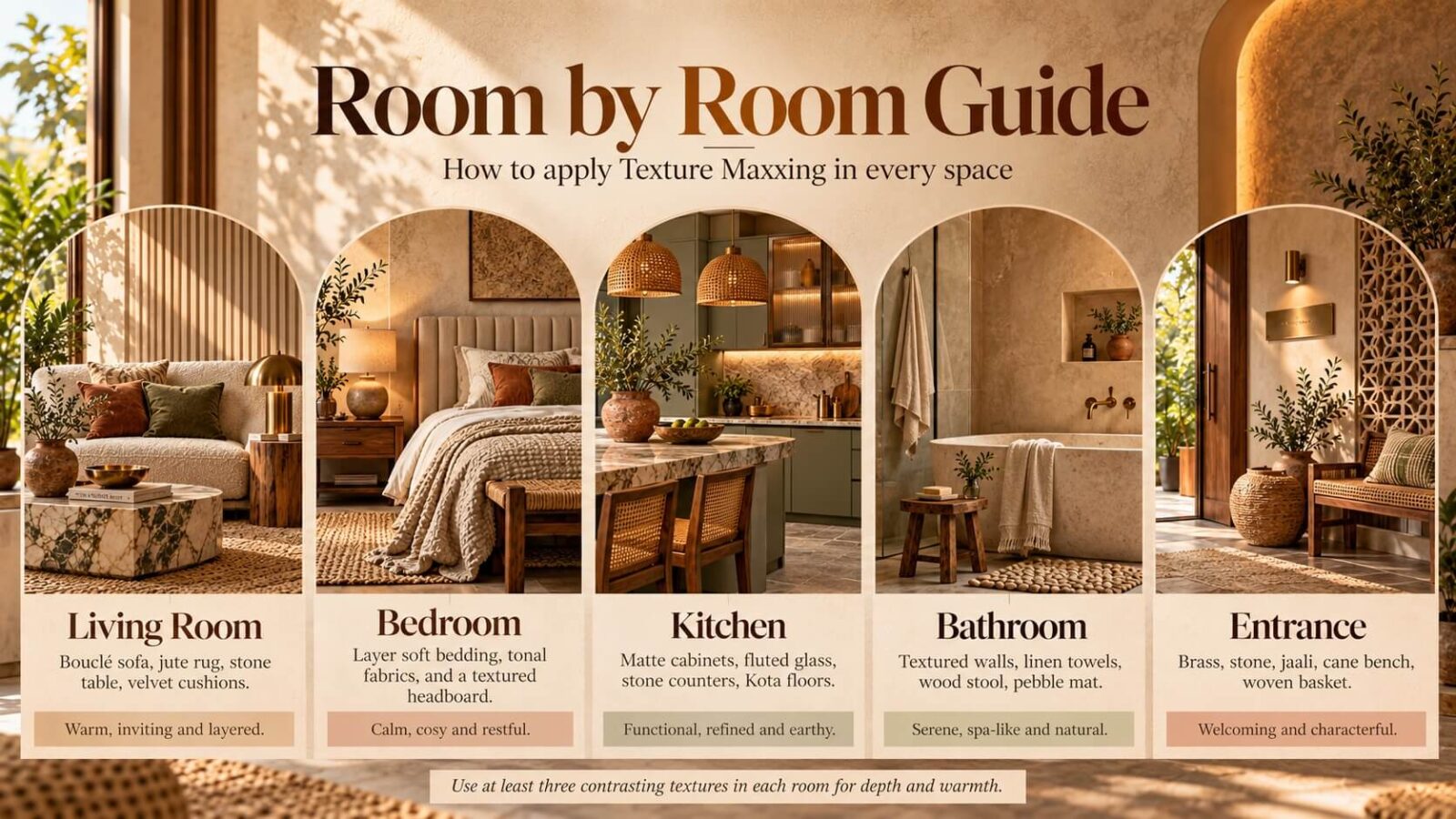
Here is how to apply the idea in each space.
Living Room
Start with the sofa. Choose bouclé, linen, or textured chenille. Add a flat-woven or jute rug beneath it. Place a marble or stone coffee table on top for contrast.
Finish with velvet cushions and a wooden side table. One fluted or limewash wall ties everything together.
Bedroom
Layer bedding the way luxury hotels do. Use cotton percale sheets, a quilted coverlet, and a chunky knit throw. A fluted or upholstered headboard adds depth.
Keep the palette tonal. Soft rugs on both sides of the bed make mornings kinder.
Kitchen
Pair matte cabinets with fluted glass shutters. Choose honed stone countertops over high-gloss ones. Cane pendant lights add warmth overhead.
Kota stone floors work well here. They stay cool and hide daily wear.
Bathroom
Try tadelakt-style plaster or textured tiles on one wall. Add a wooden stool and linen towels. Pebble mats look lovely, but choose anti-slip options for safety.
Entrance
First impressions matter. Use a handcrafted brass nameplate, stone tiles, or a jaali panel. A cane bench with a woven basket completes the welcome.
Indian Materials That Suit Texture Maxxing
India’s craft heritage gives this trend a natural home. Many materials are local, affordable, and beautiful.
| Material | Texture | Best use | Care tip |
|---|---|---|---|
| Kota stone | Cool and honed | Floors, window sills | Seal once a year |
| Jute and cane | Coarse and woven | Rugs, pendants, chairs | Keep dry, dust weekly |
| Block print cotton | Soft and printed | Cushions, curtains | Wash in cold water |
| Terracotta | Matte and earthy | Planters, wall tiles | Seal against stains |
| Sheesham wood | Grainy and warm | Tables, wall panels | Polish twice yearly |
| Khadi and handloom | Slubby and breathable | Throws, drapes | Dry clean when needed |
| Brass | Smooth and warm | Lamps, handles | Polish monthly |
| Jaali screens | Patterned and airy | Partitions, balconies | Brush off dust |
The style becomes personal when it uses local craft. A Jaipur block print cushion tells a story that a factory item cannot.
Climate Check: Textures That Survive Indian Weather
Here is an angle most trend articles skip. A texture that suits London may struggle in Delhi. Heat, dust, and humidity change what lasts.
| Region | Main challenge | Smart choices | Use sparingly |
|---|---|---|---|
| Delhi NCR | Dust and fierce summers | Washable linen, sealed stone, cotton rugs | Long-pile wool, heavy velvet |
| Mumbai and coastal cities | High humidity | Sealed cane, teak, ceramic | Untreated jute, raw leather |
| Hill stations | Cold and damp | Wool, sheepskin, wood panels | Cold glossy surfaces |
| Hot dry regions | Heat and strong sun | Lime plaster, terracotta, cotton | Dark synthetic fabrics |
Texture Maxxing needs a climate-smart plan in India. Pick fabrics you can wash and surfaces you can wipe.
Colour and Light: The Secret Partners
Texture needs the right backdrop to shine. Keep your palette to three related colours. Beige, greige, clay, olive, and charcoal work beautifully.
Light matters even more. Try the grazing light trick. Place a wall washer or sconce close to a textured wall. The side light throws tiny shadows that reveal every ridge and grain.
Warm bulbs between 2700K and 3000K flatter natural materials. Cold white light flattens them.
Pairings That Work: A Quick Cheat Sheet
Contrast is the engine of this look. Pair opposites and the room starts to hum.
| Pair this | With this | Why it works |
|---|---|---|
| Bouclé | Polished marble | Soft comfort meets cool sleekness |
| Jute | Velvet | Coarse fibres ground the plush fabric |
| Rough lime plaster | Brass | Matte earth meets warm shine |
| Cane | Linen | Airy weave meets relaxed fabric |
| Fluted wood | Smooth glass | Linear ridges meet clean surfaces |
| Terracotta | Cotton | Earthy clay meets breathable softness |
Texture Maxxing thrives on these small tensions. Keep each pairing within your three-colour palette.
A Weekend Texture Makeover Plan
Want results fast? Try this simple schedule on one room.
| Time | Task | Quick tip |
|---|---|---|
| Saturday morning | Declutter and remove items with the same feel | Keep only pieces you truly love |
| Saturday afternoon | Shop for a rug, cushions, and a throw | Carry fabric swatches from home |
| Sunday morning | Rearrange using the 60-30-10 rule | Take a photo before and after |
| Sunday afternoon | Fix the lighting | Move one lamp to graze a wall |
Photos help more than you think. A phone camera flattens colour but exaggerates surface. If the texture reads well on screen, it will read well in person.
Little-Known Facts Behind the Trend
Many textures in this trend are far older than the trend itself.
- Lime plaster has covered Indian walls for centuries. It lets walls breathe and manages indoor moisture naturally.
- Kota stone is a fine-grained limestone from Rajasthan. Its slightly rough finish grips well underfoot.
- Jaali screens filter light and air in Mughal and Rajput architecture. Today they double as luxury partitions.
- Handloom fabrics show small irregularities. Those slubs are a sign of craft, not a defect.
Sustainable Luxury: The Craft Angle
Texture Maxxing also fits the slow living movement. Jute, cane, bamboo, terracotta, and lime plaster come from natural sources. Many age gracefully and develop a patina instead of looking worn.
Buying handloom and handmade pieces supports artisans directly. It also gives your home a story. Guests will ask where your throw came from, and you will enjoy answering.
Texture Maxxing on a Budget
You do not need a luxury budget to begin. These figures are indicative and vary by city and brand.
| Budget (approx.) | What to upgrade | Visual impact |
|---|---|---|
| ₹5,000 to ₹15,000 | Cushion covers, a throw, a jute rug, woven baskets | Moderate |
| ₹15,000 to ₹50,000 | One textured accent wall, cane chairs, linen curtains | High |
| ₹50,000 to ₹2 lakh | Fluted panelling, stone coffee table, custom upholstery | Very high |
| Above ₹2 lakh | Full lime plaster, handcrafted joinery, designer rugs | Luxury level |
Start small. Change the cushions and one rug first. Live with them for two weeks. Then decide where to invest more.
Common Mistakes to Avoid
- Using many loud textures of equal size. Let one texture lead.
- Ignoring maintenance. Delicate fabrics fail in homes with kids and pets.
- Choosing only matte surfaces. Add a little sheen for balance.
- Mixing too many wood tones. Limit yourself to two.
Never skip the touch test. Run your palm across every sample. Sit on a sofa fabric for five minutes. Rub a cushion cover against your forearm. If it irritates you, leave it.
Your Texture Maxxing Checklist
Use this list before you shop.
- Choose a three-colour palette first.
- Pick textures from at least four families.
- Apply the 60-30-10 rule to every room.
- Do the touch test on every fabric sample.
- Check care needs against your city’s climate.
- Add at least one handmade or local craft piece.
- Mix matte and glossy finishes.
- Plan warm, grazing light for textured walls.
- Set a budget and buy in stages.
Three Styling Habits Designers Swear By
- Vary the scale. Mix chunky weaves with fine ones. A large cable knit throw beside a tight linen cushion creates rhythm.
- Repeat a texture twice. If you use cane on a chair, echo it in a lamp or tray. Repetition makes a room look planned.
- Leave breathing space. Empty surfaces let textured pieces stand out. Not every shelf needs an object.
Review the room after one week. Remove a single item, then judge again. Trust your hands, because a surface that feels wrong usually looks wrong too.
Final Thoughts
Texture Maxxing proves that luxury is something you feel, not just something you see. It rewards patience, curiosity, and a love of craft. Start with one room. Add three textures you love. Step back, switch on a warm lamp, and let your hands judge the result.
Looking for more home decor ideas, Vastu tips, and housing guides? Visit Zen Nest Living for expert articles on interiors, real estate, and smart living. Explore our latest posts, pick a trend you love, and turn your house into a warm, textured home.
FAQs
1. What is Texture Maxxing in interior design?
Texture Maxxing is a design approach that layers many tactile surfaces in one space. Designers mix soft, rough, smooth, natural, and handmade materials. The aim is depth and warmth without heavy colour or clutter.
2. How do I avoid clutter while following this trend?
Use the 60-30-10 rule. Keep one calm base texture, one supporting texture, and one bold accent. Stick to three related colours. Remove accents whenever the room feels busy.
3. Is Texture Maxxing suitable for small Indian flats?
Yes. Small rooms benefit from texture because it adds depth without extra furniture. Choose lighter shades, avoid bulky pieces, and limit bold accents to one or two items. A single textured wall can transform a compact living room.
4. Which textures last longest in Indian weather?
Sealed stone, teak, lime plaster, terracotta, and washable cotton or linen last longest. They handle dust, heat, and humidity well. Avoid untreated jute and heavy velvet in damp or very dusty homes.
