
Ghaziabad has quietly turned into one of the most talked about property markets in Delhi NCR, and much of that transformation traces back to a single institution steering the city’s growth. The Ghaziabad Development Authority sits at the centre of every major infrastructure project, housing launch and zoning decision that shapes how the city looks today and how it will look by 2031. Whether you are a first time buyer eyeing an affordable plot or an investor tracking long term appreciation, understanding how this authority works gives you a genuine advantage.
This guide breaks down the role of the Ghaziabad Development Authority, unpacks the newly approved Master Plan 2031, walks through the current housing and plot schemes, and explains why 2026 is shaping up to be a meaningful year for property buyers in the region.
What Is the Ghaziabad Development Authority?
The Ghaziabad Development Authority, commonly known as GDA, was set up in 1973 under the Uttar Pradesh Urban Planning and Development Act. It functions as the principal planning body for Ghaziabad city along with Loni, Muradnagar and Modinagar. Its responsibilities span land acquisition, master plan preparation, zonal development, building plan sanctions, housing schemes and property auctions.
In practical terms, the Ghaziabad Development Authority decides where residential colonies come up, which stretches of land are reserved for commerce or industry, and how roads, sewage lines, parks and water supply are planned across the city. Every housing project, plotted development or group housing scheme that carries legal sanctity in Ghaziabad passes through this authority’s approval process at some stage.
Master Plan 2031: A New Blueprint for the City
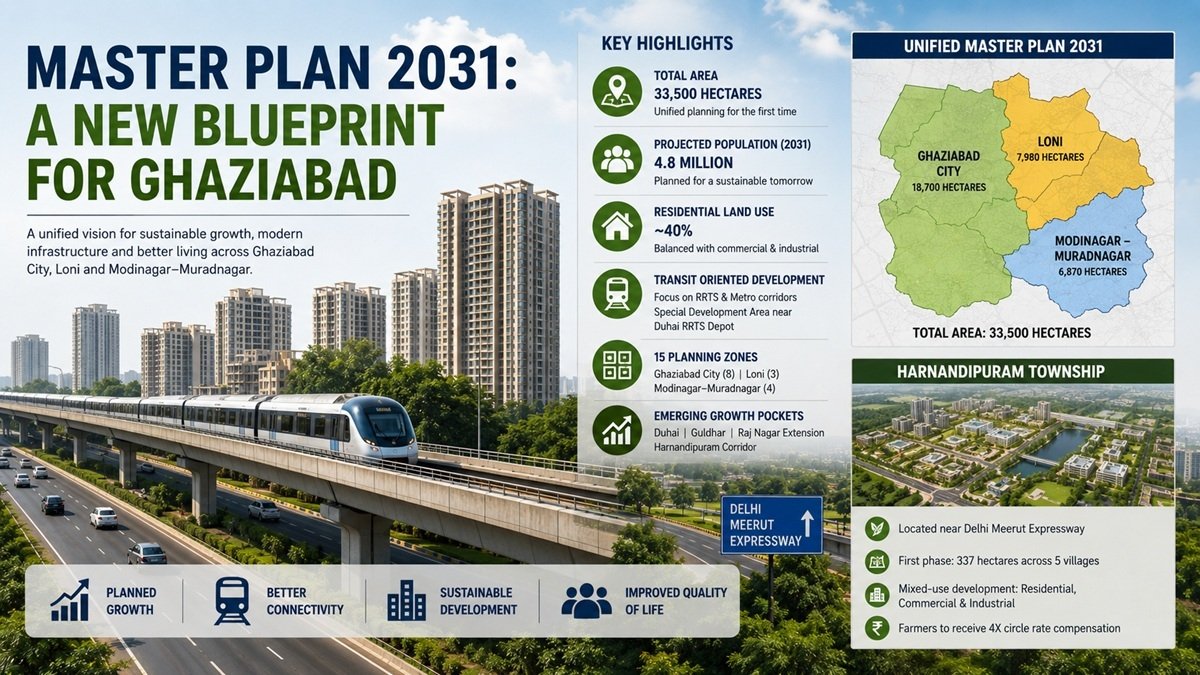
After years of delays and revisions, the state government gave its approval to the unified Master Plan 2031 in August 2025, and the authority has since been working through implementation. This is arguably the most significant document guiding the city’s future, and it deserves a buyer’s full attention.
The plan spans close to 33,500 hectares, covering Ghaziabad city, Loni and Modinagar-Muradnagar together for the first time under one unified framework. Ghaziabad city alone accounts for roughly 18,700 hectares, with Loni contributing around 7,980 hectares and Modinagar close to 6,870 hectares. To manage a population expected to touch 4.8 million by 2031, nearly 40 percent of this land has been earmarked for residential use, with a smaller share reserved for commercial activity.
A defining feature of Master Plan 2031 is its emphasis on transit oriented development. Zones located along the Regional Rapid Transit System and metro corridors have been given special attention, including a dedicated Special Development Area near the Duhai RRTS depot. The city has also been reorganised into 15 zones, with Ghaziabad city divided into eight zones, Loni into three, and Modinagar-Muradnagar into four, each expected to receive a detailed zonal development plan from consultants appointed by the authority.
Perhaps the most ambitious project tied to this master plan is the proposed Harnandipuram township near the Delhi Meerut Expressway. The first phase alone involves acquiring nearly 337 hectares across five villages for a mixed use development that will include residential, commercial and industrial zones. To encourage landowners to participate, farmers are being offered compensation at four times the applicable circle rate, and direct land purchases have already begun.
For property buyers, the master plan signals where future demand is likely to concentrate, including emerging pockets such as Duhai, Guldhar and Raj Nagar Extension, alongside the upcoming Harnandipuram corridor.
Latest Housing and Plot Schemes in 2026
The Ghaziabad Development Authority has been unusually active on the housing front through 2026, launching several schemes that cater to different budgets and buyer profiles.
- Nandgram or Noornagar Plot Scheme: Launched in February 2026, this scheme offers 77 residential plots ranging from 60 to 221 square metres in the Rajnagar Extension area, priced at around Rs 79,000 per square metre. Notably, this marked the first major plotted scheme from the authority in almost 14 years, and applications were followed by an e-lottery process in April 2026.
- Madhuban Bapudham Plot Scheme: Rolled out under the state’s “Apni Zameen Apna Aasman” initiative, this scheme brought 350 freehold residential plots to the market, sized between 40 and 200 square metres. Prices start close to Rs 14 lakh for the smallest plots and rise to roughly Rs 70 lakh for the largest, making it accessible across income groups. Allotment again followed a transparent e-lottery format.
- First Come First Serve Scheme: For buyers who prefer not to wait through lottery cycles, the Ghaziabad Development Authority runs a dedicated FCFS portal that allows direct booking of available flats and plots, subject to inventory.
- Mega Sale on Unsold Inventory: To clear existing stock, the authority periodically offers discounted pricing and relaxed eligibility terms on unsold flats and plots, including 2BHK units in Madhuban Bapudham priced around Rs 3,700 per square foot.
- Regular Auctions: Throughout the year, the Ghaziabad Development Authority conducts e-auctions and physical auctions covering residential, commercial and institutional plots along with shops and kiosks across schemes like Indirapuram, Indirapuram Extension and Madhuban Bapudham.
Income based reservations remain part of most schemes, with categories spanning EWS, LIG, MIG and HIG, and statutory reservations for SC/ST, OBC, persons with disabilities and ex-servicemen built into the allotment process.
Why Property Investment in Ghaziabad Looks Promising in 2026
Several factors are converging to make 2026 a genuinely interesting window for property investment in this city.
Connectivity has improved sharply with the operational RRTS corridor linking Ghaziabad to Delhi and Meerut, cutting commute times that once made the city feel peripheral. The Delhi Meerut Expressway continues to pull commercial and residential interest along its length, and metro extensions have brought previously overlooked pockets into the mainstream housing conversation.
Pricing still favours buyers compared with Noida or Gurugram, particularly in plotted developments where government backed schemes offer land at rates well below open market comparables. Localities such as Raj Nagar Extension, Indirapuram, Vaishali and Crossing Republik continue to see steady demand, whilst newer corridors near Duhai and the upcoming Harnandipuram township are attracting early stage investors betting on long term appreciation.
The state government’s proposed model costing guidelines could also bring pricing relief, with reports suggesting unsold inventory across the authority’s stock could see reductions of up to 25 percent, a move that would further sweeten entry points for buyers this year.
How the GDA Housing Scheme Application Process Works
Applying for a scheme typically follows a consistent pattern. Interested buyers first purchase the scheme brochure, either online through the official portal or via the state’s Jansunwai website, usually for a nominal fee. Aadhaar and PAN details are mandatory during registration. Once applications close, eligible entries move into an e-lottery for transparent allotment, and successful applicants are notified to complete payment formalities within a specified window.
Buyers should always verify scheme details directly on the authority’s official channels before making payments, since brochure fees, plot pricing and deadlines vary between schemes and get revised periodically.
Points Buyers Should Keep in Mind
Government schemes come with real advantages such as clear titles, regulated pricing and freehold ownership, but they also demand patience. Lottery based allotments mean outcomes are not guaranteed, possession timelines can stretch depending on infrastructure readiness, and documentation requirements are strict. It helps to track official announcements from the Ghaziabad Development Authority closely, compare plot locations against the Master Plan 2031 zoning, and factor in future connectivity rather than only current access when shortlisting a scheme.
Final Thoughts
The Ghaziabad Development Authority continues to shape one of NCR’s most active real estate corridors, and 2026 has already brought a flurry of plot launches, auctions and policy movement tied to Master Plan 2031. For buyers willing to navigate the application process patiently, the current cycle of schemes offers a rare combination of affordability, transparent allotment and long term growth potential backed by improving connectivity across the region.
Ready to make a confident property decision in Ghaziabad? Zen Nest Living helps you compare verified housing schemes, plotted developments and investment hotspots across the city, so you can shortlist the right option, understand pricing trends and move forward with complete clarity before you invest.
Frequently Asked Questions
1. What is the Ghaziabad Development Authority responsible for?
The Ghaziabad Development Authority is the statutory body overseeing planned urban development across Ghaziabad, Loni, Muradnagar and Modinagar. It handles land acquisition, master plan preparation, building approvals, housing schemes and property auctions.
2. When was Master Plan 2031 approved?
The Uttar Pradesh government approved the unified Master Plan 2031 in August 2025, covering Ghaziabad city, Loni and Modinagar-Muradnagar under a single planning framework extending land use decisions up to 2031.
3. How can I apply for a GDA housing or plot scheme?
Applicants need to purchase the scheme brochure online, register with Aadhaar and PAN details, and submit their application before the deadline. Allotment for most schemes is done through a transparent e-lottery system.
4. Is investing in Ghaziabad property a good idea in 2026?
Improved RRTS and metro connectivity, competitive pricing compared with neighbouring NCR cities, and active government schemes make several Ghaziabad localities attractive for both end users and long term investors this year.