
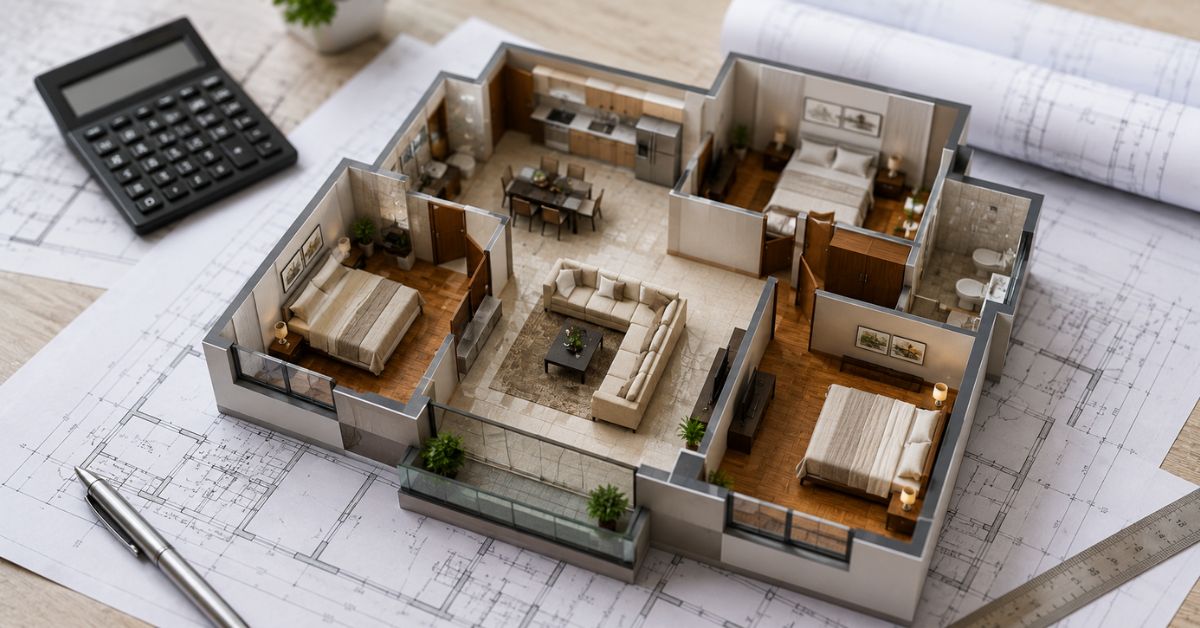
Purchasing a house is one of the largest monetary decisions of your life. You compare prices, check out websites and analyse floor plans thoroughly. However, one term is more confusing than any other to home buyers. That is called carpet area. Before RERA, various builders had different ways of defining and calculating carpet area. People who bought land often paid for land they didn’t use or even have access to. This led to a lot of confusion and numerous disagreements in the Indian real estate industry.
With the introduction of the Real Estate (Regulation and Development) Act, 2016, the definition of carpet area was standardised, providing much-needed clarity. Now it has become the legal base of all the sale agreements in RERA-registered projects. When it comes to purchasing a house, knowing the RERA carpet area meaning is crucial.
What Is RERA Carpet Area?
The carpet area of a flat or unit is the actual usable area, which is known as the RERA carpet area. This covers the space in all rooms where it is possible to move around or place furniture. Think of it as the maximum carpet surface area possible.
Indian law, for the first time, officially recognised the carpet area in real estate. It is defined in the RERA Act, 2016, under Section 2(k): Carpet area is defined as the area of the apartment less the area of the external walls, area under services shafts, exclusive balcony or verandah area, exclusive open terrace area and plus the area of the internal partition walls of the apartment.
This is a legally binding definition applicable to all registered developers in India. It is a standard which is regulated and monitored by the State RERA authorities. This definition cannot be changed by any builder or used to calculate a different measurement method.
What Does RERA Carpet Area Mean in Simple Terms?
RERA carpet area is the space you can use within your apartment. It includes all rooms in which you live, cook, sleep and relax. This includes bedrooms, living room, dining area, kitchen and all bathrooms. Internal corridors that join these rooms are also included in the carpet area.
One of the important things to know about the carpet area definition by RERA is that the internal partition walls are included in the carpet area. The RERA definition considers the internal wall thickness besides the regular carpet area. Usually, this difference makes the RERA carpet area around 5% more than the traditional carpet area.
There is a very basic principle that is at work here. Space which can be accessed is part of the RERA carpet area, if it can be furnished. An area outside your unit, or that is inaccessible to you, is not in scope.
What RERA Carpet Area Includes
The RERA carpet area includes all the livable and functional areas of your apartment. What is covered in the definition under the Act is the following.
RERA carpet area includes all bedrooms of the flat. The living and dining rooms are completely covered by the carpet. The kitchen area is included in the carpet area. Bathrooms and toilets inside the unit are counted in the RERA carpet area. Not only internal corridors, but also passageways within your flat. Even the area occupied by the internal partition walls is also included in the carpet area as per RERA.
According to the RERA definition, all the spaces that are built between the inner walls of a house are included. Traditional measurements would not take into account the thickness of the inner walls, which would result in understated carpet area figures. RERA changes all this and provides a more comprehensive view to buyers.
What RERA Carpet Area Excludes
Not all the areas associated with your apartment are part of the RERA carpet area. There are a number of areas which are not, under the law, part of the definition.
The carpet area does not include the area of external walls, service shaft areas, exclusive balcony or verandah area and exclusive open terrace. This does not include common areas like lobbies, staircases or lift shafts.
Builders should not ignore balconies and terraces just because they are not included in the exclusion. The RERA carpet area, balcony area and any other exclusive area should be listed as three different areas by the builders. Balconies of any type (open or closed) are not included in the carpet area. This disclosure is separate so that the carpet area number remains true and there is no inflation of usable area.
RERA Carpet Area Calculation: A Step-by-Step Guide
By knowing the RERA carpet area calculation, one can always check any property measurement on their own. As per the formula, RERA carpet area is calculated as: RERA Carpet Area = Internal Partition Wall Areas + Net Usable Area. Net usable area is the area of all spaces less the area of any external walls, open terraces, balconies or verandahs.
Here are the steps to calculate the RERA carpet area of any apartment.
Step 1: Measure each room separately.
Measure the inside wall to inside wall length and width of each room. Calculate area of each room by multiplying the two numbers together. Bedrooms, living room, kitchen and all bathrooms.
Step 2: Measure the internal corridors.
The area of the carpet is the internal passageways and corridors of your flat. Measure the length and width, and find the area of each.
Step 3: Add Internal Partition Wall Area
Review the floor plan and all internal partition wall thicknesses. Find the total length of all these walls in the unit. Multiply the wall thickness by the total wall length to get the partition wall area.
Step 4: Sum up All Figures
Include the area of all rooms, internal corridors and internal partition walls. The sum would be the RERA carpet area of the apartment.
Here is a practical example using a 2BHK apartment:
Master bedroom: 180 sq ft Second bedroom: 130 sq ft Living and dining area: 200 sq ft Kitchen: 70 sq ft Two bathrooms at 30 sq ft each: 60 sq ft Internal corridor: 40 sq ft Internal partition wall area: 20 sq ft
RERA Carpet Area = 180 + 130 + 200 + 70 + 60 + 40 + 20 = 700 sq ft
This figure is the legally defined and verifiable usable space in the apartment.
RERA Carpet Area vs Built-Up Area vs Super Built-Up Area
There are three area terms which are most commonly used in the conversation of real estate in India. All homebuyers will come across them when researching about home. Knowing their differences enables you to make an accurate assessment of any property.
RERA Carpet Area
This is the net floor area of your apartment that is usable as described in Section 2(k). It does not include external walls or balconies, but does include internal partition walls. It is the most precise and buyer-friendly measurement of the present times in Indian real estate.
Built-Up Area
Built-up area comprises the carpet area, walls, balconies, corridors and common spaces such as staircases, etc. It is usually 10-20% more than the carpet area. If the carpet area of a flat is 700 sq ft, then the built-up area of the flat could be 770 to 840 sq ft based on the project layout.
Super Built-Up Area
The super built-up area includes the built-up area and the amenities such as the clubhouses, pools and so on, typically about 25 to 30 percent larger than the built-up area. The total common area is allocated proportionately to all the apartments in the project by the builders.
A 700 sq ft carpet area flat may carry a super built-up area of 875 sq ft or more. In high-density cities like Mumbai, loading factors can often reach 45 to 50 percent, meaning the carpet area is barely half of the super built-up area.
Before RERA, developers often quoted the price per square foot based on the inflated super built-up area to make the property seem cheaper. Under RERA, all registered projects must price properties based on carpet area only.
Read More: Carpet Area Super Area Dispute: What Every Homebuyer Must Know
Why RERA Carpet Area Matters to Every Homebuyer
The RERA carpet area definition is a game-changer in the Indian real estate market. Here’s why it’s important to all home buyers.
Transparent, Fair Pricing
You’re now paying on the space that you can use. The builder should mention the carpet area and quote prices accordingly, and not the super built-up area. This will provide the buyer with an idea of what they are buying.
Uniform Standards Across India
The definition is common to all States in India. Builders used to use their own definitions before RERA, which was confusing. RERA carpet area is always accurate, consistent and buyer-friendly. It has become possible to compare a flat in Gurugram with a flat in Pune on an equal footing.
Legal Protection Against Area Shortfall
The carpet area can vary by a maximum of 3 percent as per RERA. If the carpet area is less during construction, the developer will have to pay the excess amount to the buyer with annual interest within 45 days. In case of an increase in the carpet area, the buyer is required to pay the additional amount up to a maximum of 3% of the carpet area that has been promised.
Clarity in Sale Agreements
All the RERA-registered projects are required to publicly state the carpet area on the internet. This information can be checked on the official state RERA portal anytime. This transparency keeps builders accountable for the entire sales and construction process.
Better Resale Value
Even the resale market is greatly affected by the RERA carpet area. One of the first things buyers look at when buying an apartment is the space that is usable to them. The higher carpet area (as per RERA) will mean more living area for the next owner, and that will have a direct impact on the resale value of your property. In the industry, a 70 percent or higher ratio is a good one.
Real Estate Before RERA: A Look Back
Before RERA came into force in 2017, no universal carpet area definition existed in Indian law. Different states, cities, and builders applied different measurement methods. A 1,000 sq ft apartment in one project was often not comparable to a flat of the same size in another. Builders frequently calculated prices based on the super built-up area.
For decades, Indian homebuyers struggled with confusing terms and builders who often quoted inflated sizes, leaving buyers paying for space they could not actually use. The highest number of consumer court cases in India’s real estate sector related to area disputes and misleading measurements. Homebuyers had no legal standard to cite when raising complaints. RERA solved this by codifying carpet area directly in the law and making compliance mandatory.
How to Use RERA Carpet Area When Buying a Property
- Always enquire the builder about the RERA carpet area of the unit that you are intending to purchase. Don’t take brochure or sales pitch super-built-up area figures on faith. To find out the actual cost of space, use the carpet area to calculate the price per square foot.
- Always check the price per sqft on the basis of the RERA carpet area. It’s the only method to compare the real expense of your genuine living space. Don’t pay attention to the super built-up price because it is the price of shared facilities that you do not own.
- Always be sure to review the carpet area number thoroughly before signing the sale contract. Ensure that balconies, terraces and service areas are identified separately in the document. If any measurement is unclear, ask for a written clarification from the builder before signing.
- The carpet area of any RERA-registered project can be checked anytime on the official RERA website of the concerned state. A declared carpet area which is not equal to the actual carpet area is a violation of the law under the Act.
RERA Carpet Area and Your Home Loan
Your RERA carpet area also comes into play when planning your home loan. The usable area is used by banks and Housing Finance Companies for determining the market value of the property. If the carpet area is verified, the lenders will have a proper base on which they can sanction the loan amount.
Make sure that the RERA carpet area is properly mentioned in your home loan documents. If you have an accurate figure, there will be no mismatch between the sale agreement and the loan sanction letter. This uniformity helps to accelerate the documentation and disbursement process. You can also plan your interiors, flooring requirements and furniture layouts more accurately with an accurate carpet area figure.
Key Questions to Ask Your Builder About RERA Carpet Area
Ask these questions directly to your builder before signing anything.
How many square feet is the RERA carpet area of this flat? What is the super built-up area, and what is the loading factor applied? Does the sale agreement specify balcony/terrace areas separately? Has this project been registered with RERA in the concerned state? What if the carpet area provided is not as promised?
A builder who is adhering to RERA guidelines will be able to answer these questions in a clear manner with the help of written responses. If they hesitate or give vague answers, you should dig deeper and don’t spend your money.
Conclusion
RERA carpet area is one of the key legal safeguards for homebuyers in India. It is a single, enforceable measurement that takes the place of vague and inflated measurements. With the RERA carpet area meaning, you can check any property with full confidence. With the RERA carpet area calculation, you will get clarity on the carpet area you are paying for. Always start at the carpet area when purchasing a first home or investing in homes. It is the most trustworthy, transparent and buyer-friendly measurement available in the Indian real estate sector today.
We hope this RERA Carpet Area guide answered all your questions related to it. If you are looking to buy a new home, or looking for any flat, want to do home decore, or need vastu related information, always reach Zen Nest Living and find answers to your queries.
