
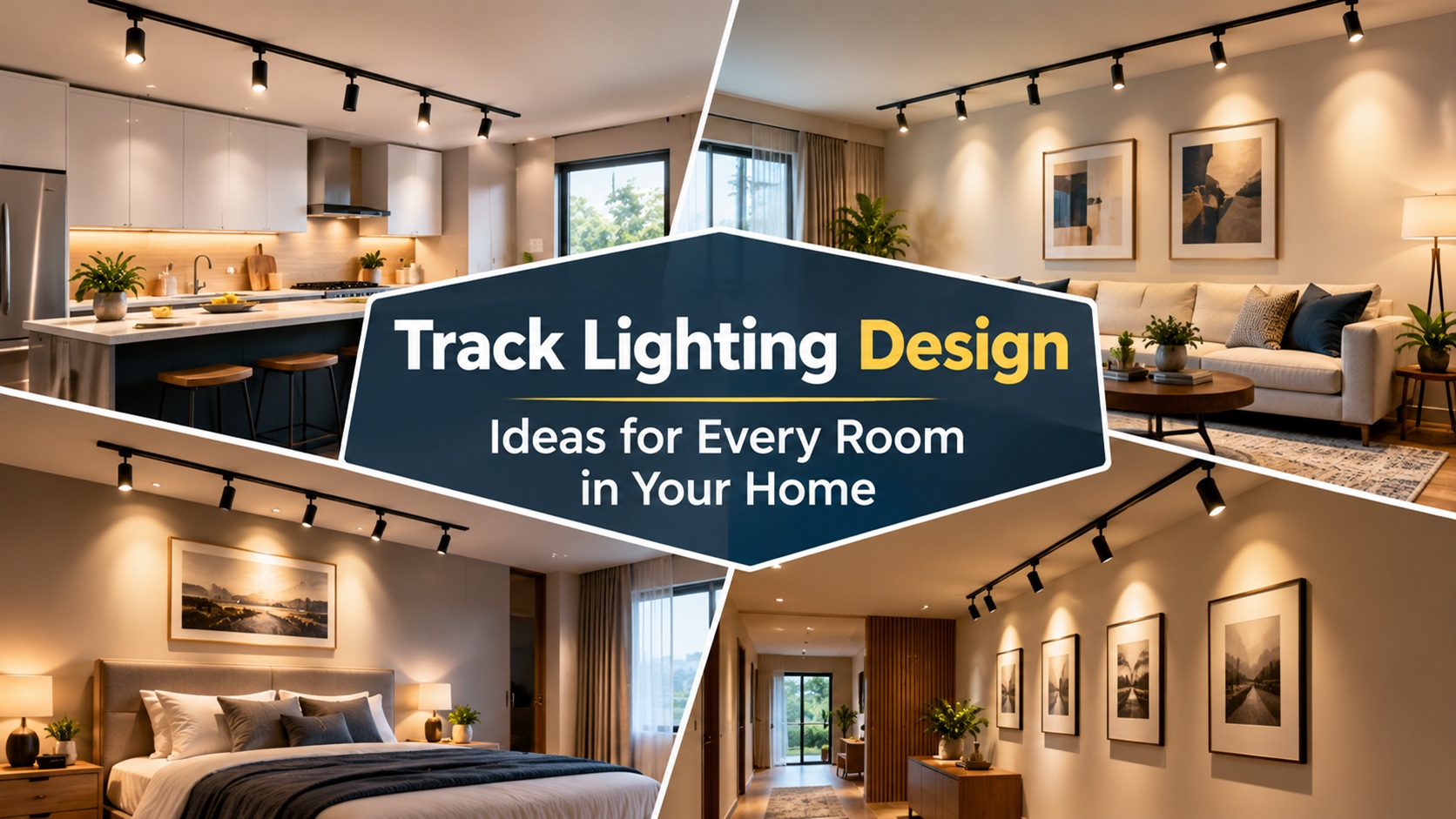
A single ceiling light rarely does the job. It leaves dark corners, flattens your furniture and throws shadows right where you need to see. Track lighting solves this by letting you point light exactly where it is useful.
Good track lighting design is not about buying a rail and clipping on a few spotlights. It is about deciding what each light should do, where it should land and how it should feel at different times of day.
This guide covers how track lighting works, the main types, how to plan a layout and room-by-room ideas you can use. It also covers the mistakes that make a well-meant setup look messy.
What Is Track Lighting?
Track lighting is a system with a rail (the track) fixed to the ceiling or wall, and individual light heads that attach anywhere along it. You can slide, rotate and tilt each head, and add or remove heads as your needs change.
That flexibility is why people choose it. A fixed downlight stays where it was installed. You can reposition a track light in a minute when you move a sofa or hang new art.
Why Track Lighting Design Matters
Poor planning is the most common reason track lighting looks bad. Spread heads out randomly and you get glare, harsh spots and a cluttered ceiling. Plan it well and you get a few clear benefits:
- Layered light: Track heads can provide accent light, task light or general light, depending on where you aim them.
- Easy changes: You can adjust the setup without opening the ceiling.
- Less wiring work: One power point can feed a whole run of lights.
- Better use of space: In rooms where a central fixture would feel too heavy, a slim track keeps the ceiling clean.
Types Of Track Lighting Systems
Knowing the options helps you pick the right one before you plan the layout.
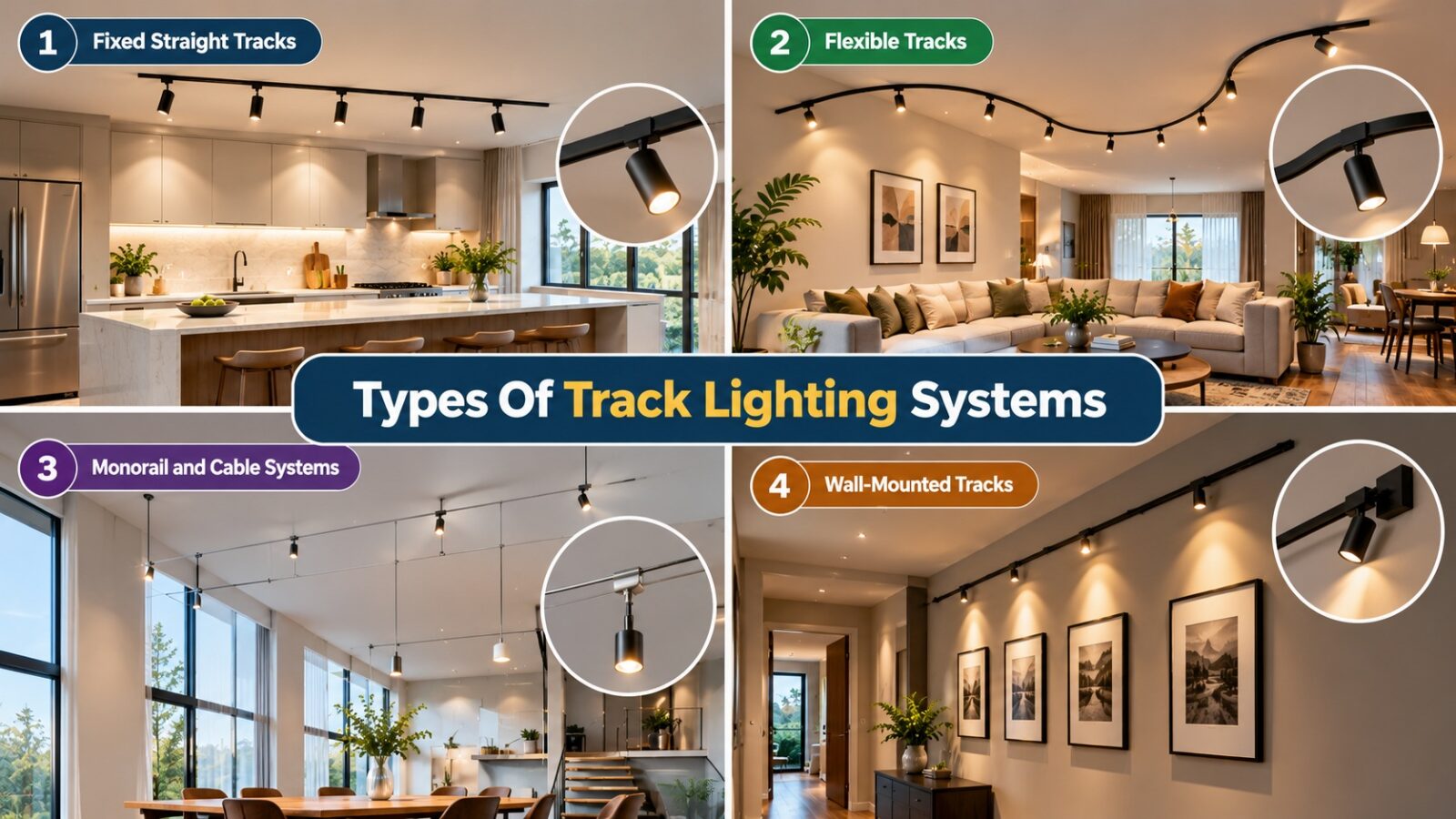
Fixed Straight Tracks
This is the classic setup: a straight rail with heads clipped on. It suits kitchens, hallways and long, narrow rooms. It is simple, affordable and easy to install.
Flexible Tracks
Flexible tracks bend and curve, so you can make gentle waves or follow the shape of a room. They work well in open-plan spaces or where you want the lighting to feel less rigid. Keep the curves simple. Too many bends can look busy.
Monorail and Cable Systems
These use a low-voltage rail or suspended cables, with pendants or small spotlights hanging from them. They look light and modern, and they are a good fit for higher ceilings or loft-style rooms.
Wall-Mounted Tracks
A track fixed along a wall can wash light across a bookshelf, a gallery wall or a textured surface. This works well when the ceiling is low or cannot take a fixture.
How To Plan A Track Lighting Layout
Before you buy anything, spend ten minutes with a pencil and the floor plan of your room.
Step 1: List What Needs Light
Write down the key spots: a reading chair, the kitchen counter, a painting, the dining table, a desk. Each one needs a light that points at it.
Step 2: Choose the Track Length
A common rule is to keep the track at least 30 to 45 cm (12 to 18 inches) away from walls. If you want to light art or shelves, place the track about 60 to 75 cm (24 to 30 inches) from the wall, so the beam lands on the surface at a flattering angle.
Step 3: Count the Heads
A simple starting point is one head for every 60 to 90 cm (2 to 3 feet) of track. Fewer heads with the right beam angle look better than many heads crowded together. You can always add more later.
Step 4: Aim at About 30 Degrees
For wall art and shelves, tilt the head about 30 degrees from vertical. A steeper angle reduces glare and keeps reflections off glass frames. Aim straight down only for task spots like counters.
Step 5: Add Dimming
Put the track on a dimmer. Bright light for cooking or cleaning and softer light for evenings makes one system work for several moods. Check that your bulbs and heads are dimmable.
Read More: Magnetic Track Light Ideas
Track Lighting Design Ideas By Room
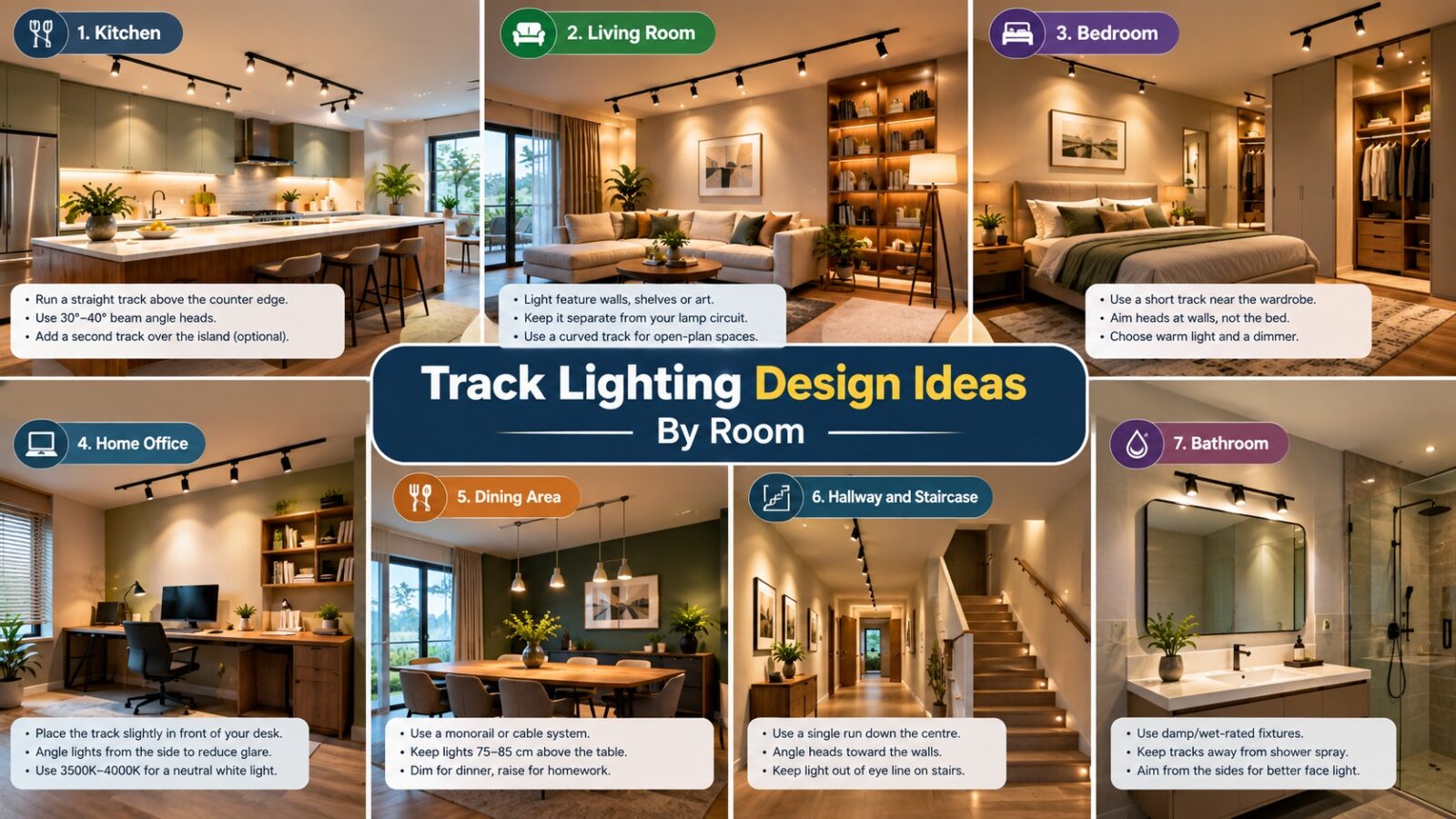
1. Kitchen
The kitchen is where track lighting earns its place. You need clear light on counters, the sink and the stove, and you do not want to cast shadows with your own body while chopping.
Idea: Run a straight track along the ceiling above the counter edge, not directly over the middle of the room. This lights the work surface from the front, so you do not stand in your own shadow. Use heads with a medium beam angle of about 30 to 40 degrees.
For an island, a short second track parallel to the first adds focused light for prep and gives a dining-bar feel.
2. Living Room
Living rooms need warm, layered light. Overhead brightness alone makes them feel flat.
Idea: Use a track to light a feature wall, a bookcase or a favourite painting, and keep it separate from your lamp circuit. A lit wall draws the eye and makes the room feel taller. Pair it with a floor lamp for reading so you are not depending on the track alone.
A gentle curve in a flexible track can follow the shape of an open-plan living and dining zone without splitting it with hard lines.
3. Bedroom
Bedrooms should feel calm. Bright spotlights aimed at the bed work against that.
Idea: Place a short track near the wardrobe or dressing area for clear light when you pick clothes. Aim any heads near the bed at the walls, not the pillows. Use a warm colour temperature and a dimmer so the room can wind down at night.
4. Home Office
Work needs even, glare-free light. A common mistake is a single spotlight that hits the screen or the desk surface harshly.
Idea: Position a track slightly in front of and above your desk, and angle the heads so the light falls on the desk from the side. This reduces screen reflection. A cooler, neutral white of 3500K to 4000K keeps the room alert without feeling clinical.
5. Dining Area
A dining table looks best with a defined pool of light.
Idea: Hang a monorail or cable system above the table with two or three pendant-style heads. Keep the bottom of the lights about 75 to 85 cm (30 to 34 inches) above the table surface. Dim them for dinner and raise them when the table doubles as a homework spot.
6. Hallway and Staircase
Corridors are often dull and under-lit. A straight track fits naturally here.
Idea: Use a single run down the centre of the ceiling with small heads angled toward the walls. If you have framed photos, aim each head at a frame. This turns a transit space into a mini gallery. On stairs, make sure the light does not shine into the eyes of someone coming down.
7. Bathroom
Track lighting can work in bathrooms, but safety comes first.
Idea: Use only fixtures rated for damp or wet areas, and keep tracks away from direct shower spray. A short track above the vanity, angled toward the mirror from the sides, gives better face light than a single bulb overhead. Check local electrical rules or ask a licensed electrician before you install.
8. Gallery Wall or Art Corner
Art needs controlled light. Too strong and it fades or glares. Too weak and it disappears.
Idea: Use narrow-beam heads with a lower brightness and a high colour rendering index (CRI), ideally 90 or above, so colours look true. Aim each head at the centre of a piece and test from a few steps back. Move the head until reflections on glass vanish.
9. Small Rooms and Apartments
In compact spaces, a heavy ceiling fixture can make a room feel smaller.
Idea: Use a slim track with matte white or black heads that blend into the ceiling. Aim some heads at the walls rather than the floor. Lit walls make a room feel wider than a bright floor does. Keep the colour temperature consistent so the space looks tidy.
10. Open-Plan Homes
When kitchen, dining and living share one room, one type of light cannot suit all zones.
Idea: Use separate tracks for each zone and put them on separate switches or dimmers. The kitchen track can be bright for work, while the living track stays warm and soft. This helps the space feel organised, even without walls.
Choosing The Right Colour Temperature And Beam Angle
These two details change how a room feels more than most people expect.
Colour temperature is measured in Kelvin (K):
- 2700K to 3000K: warm white, good for living rooms and bedrooms
- 3000K to 3500K: soft white, good for kitchens and dining areas
- 3500K to 4000K: neutral white, good for offices and workspaces
Keep every light in one room at the same temperature. Mixed tones look like a mistake.
Beam angle controls how wide the light spreads:
- Narrow (15 to 25 degrees): for art or a single object
- Medium (30 to 40 degrees): for counters and tables
- Wide (50 degrees and above): for general fill light
Choose LED heads with a CRI of 90 or higher where colour matters, such as kitchens, art walls and dressing areas.
Finishes And Styles That Work
The track and heads are part of your decor, so match them to the room.
- Matte black: a strong choice for modern, industrial or minimalist rooms. It also hides well against dark ceilings.
- White: blends into a white ceiling and keeps small rooms looking clean.
- Brushed brass or gold tones: adds warmth in traditional or boutique-style interiors.
- Brushed nickel or chrome: suits kitchens and bathrooms with metal fittings.
Pick one finish and repeat it across the room. If your cabinet handles are black, black track heads will look planned, not random.
Smart Controls And Energy Use
LED track heads use far less power than old halogen ones and run cooler, which helps both bills and comfort. Many systems now work with smart dimmers and app controls, so you can set scenes like “cooking,” “movie night” and “reading.”
If you want this, check compatibility before you buy. Not every track and driver supports every dimmer, and mismatched parts can cause flicker or a buzzing sound.
Common Track Lighting Mistakes To Avoid
Most problems come from a handful of repeated errors.
- Putting the track in the middle of the room with no purpose. A track should serve something specific. Centre-of-room placement often lights the floor and nothing else.
- Using too many heads. Crowding the track creates glare and visual noise. Start with fewer and add as needed.
- Aiming straight down everywhere. This makes harsh pools of light and dark gaps between them.
- Mixing colour temperatures. A cool white next to a warm white makes a room look inconsistent.
- Skipping the dimmer. Without one, the room has only one mood.
- Forgetting glare. If you can see the bulb from where you sit, the head is aimed or positioned wrongly. Use anti-glare snoots or deeper-set fixtures.
- Ignoring the ceiling. On a sloped ceiling, you need a compatible adapter. On a low ceiling, choose slim heads.
A Simple Example
Take a 12 by 14 foot living room with a sofa on one wall, a bookshelf on the opposite wall and a framed print above the sofa.
A practical plan would be one 6-foot track placed about 30 inches from the bookshelf wall, with three heads. Two of them aim at the shelves, and one at a reading chair. A second short track, about 2 feet, sits 24 inches from the sofa wall with one narrow-beam head aimed at the print. Both tracks go on a dimmer, with 2700K bulbs.
The result is a room with focused feature lighting and soft, glare-free general light, without a heavy central fixture.
DIY Or Professional: Which Type Of Installation Is Better?
Plug-in track kits exist that need no hardwiring, which makes them a good option for renters or simple setups. Hardwired systems, on the other hand, need correct wiring and safe connections.
If you are unsure, hire a licensed electrician. This matters most in bathrooms, high ceilings, or when you are changing existing wiring.
Final Thoughts
The best track lighting design starts with purpose. Decide what each light should highlight, choose a suitable beam angle and colour temperature, add a dimmer and keep the layout simple. A few well-placed heads will do more for a room than a ceiling full of spotlights.
Start with one room, test your angles at different times of day and adjust. The beauty of a track is that nothing is permanent.
Ready to plan lighting that suits your home? Explore more practical interior design guides, room ideas and home styling tips at Zen Nest Living. Browse our latest articles and find simple, useful ideas to make every space feel comfortable, balanced and truly yours.
Frequently Asked Questions
Is track lighting still in style?
Yes. Modern tracks are slimmer, cleaner and come in more finishes than older versions. Used with purpose, they look current and flexible.
How far apart should track lights be?
A good starting point is one head for every 60 to 90 cm (2 to 3 feet) of track. Adjust based on beam angle and what you want to light.
How many track lights do I need per room?
For an average room, three to five heads on one or two tracks is usually enough. Larger or open-plan rooms may need more, spread across separate zones.
Can track lighting be the only light in a room?
It can, but results are better when you combine it with a lamp or a wall light. Layered light feels more comfortable than one source.
What is the best colour temperature for track lighting?
For most homes, 2700K to 3000K suits living areas and bedrooms, while 3000K to 4000K suits kitchens and workspaces.
Is track lighting good for low ceilings?
Yes, if you choose slim, low-profile heads and keep the track close to the ceiling. Aim heads at walls to make the room feel taller.