
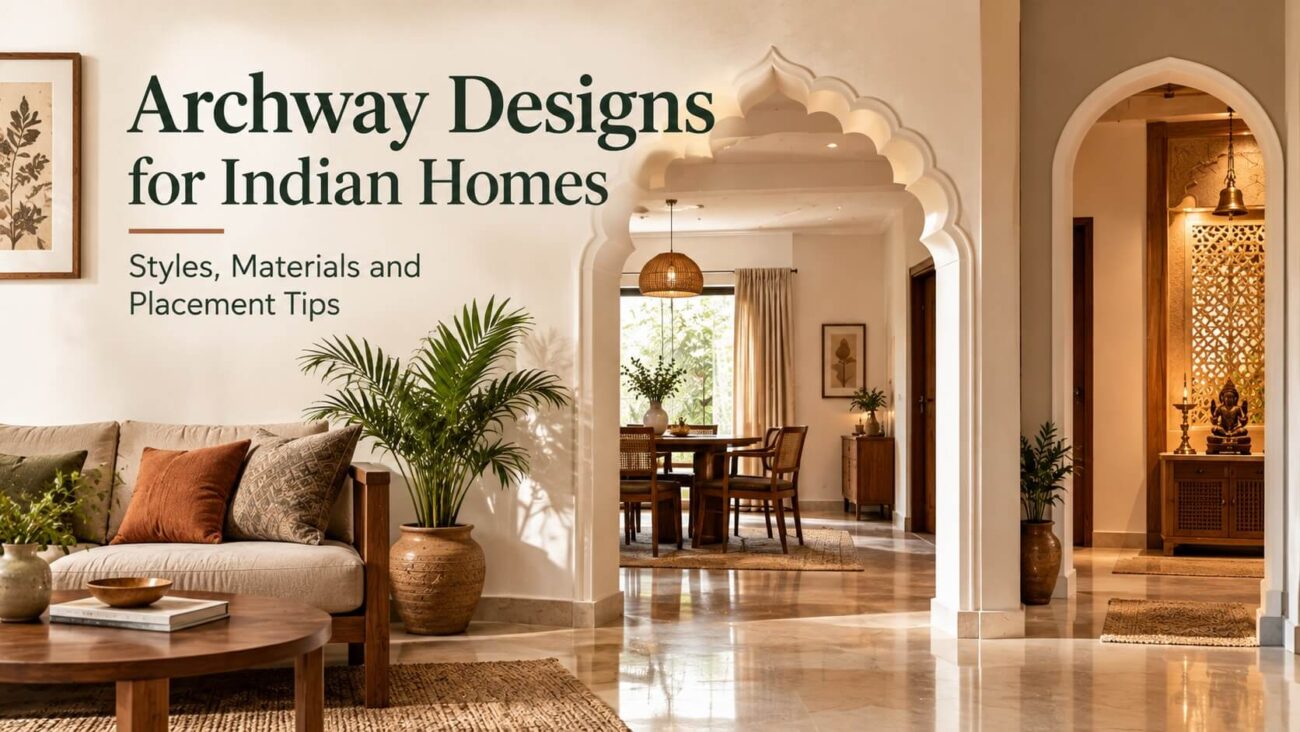
Walk into any old haveli, and the arches greet you first. They frame the courtyard, soften the stone and slow your steps.
Today, archway designs are moving into Indian flats, too. Even a compact 2BHK can borrow that old charm with one well placed curve.
This guide shows you how. You will find styles, materials, sizes, Vastu views and a few tricks most blogs skip.
Why Arches Work So Well in Indian Homes
Indian builders have shaped arches for centuries. You see them in Mughal gateways, Rajput forts, Goan churches and Kerala mansions.
That heritage gives you plenty to borrow from. You do not need a palace to use it.
Most city flats have straight walls and square rooms. An arch breaks that rigid pattern. It gives the eye one soft place to rest.
Arches also work hard. They divide a room without blocking light. They keep the kitchen connected to the living area, which many Indian families prefer.
Well planned archway designs can even make a small hall feel wider. The curve pulls the eye forward and upward.
They also help when you sell. Buyers remember a home with one striking opening.
Read More: Japandi Style for Indian Homes
Eight Archway Designs to Consider
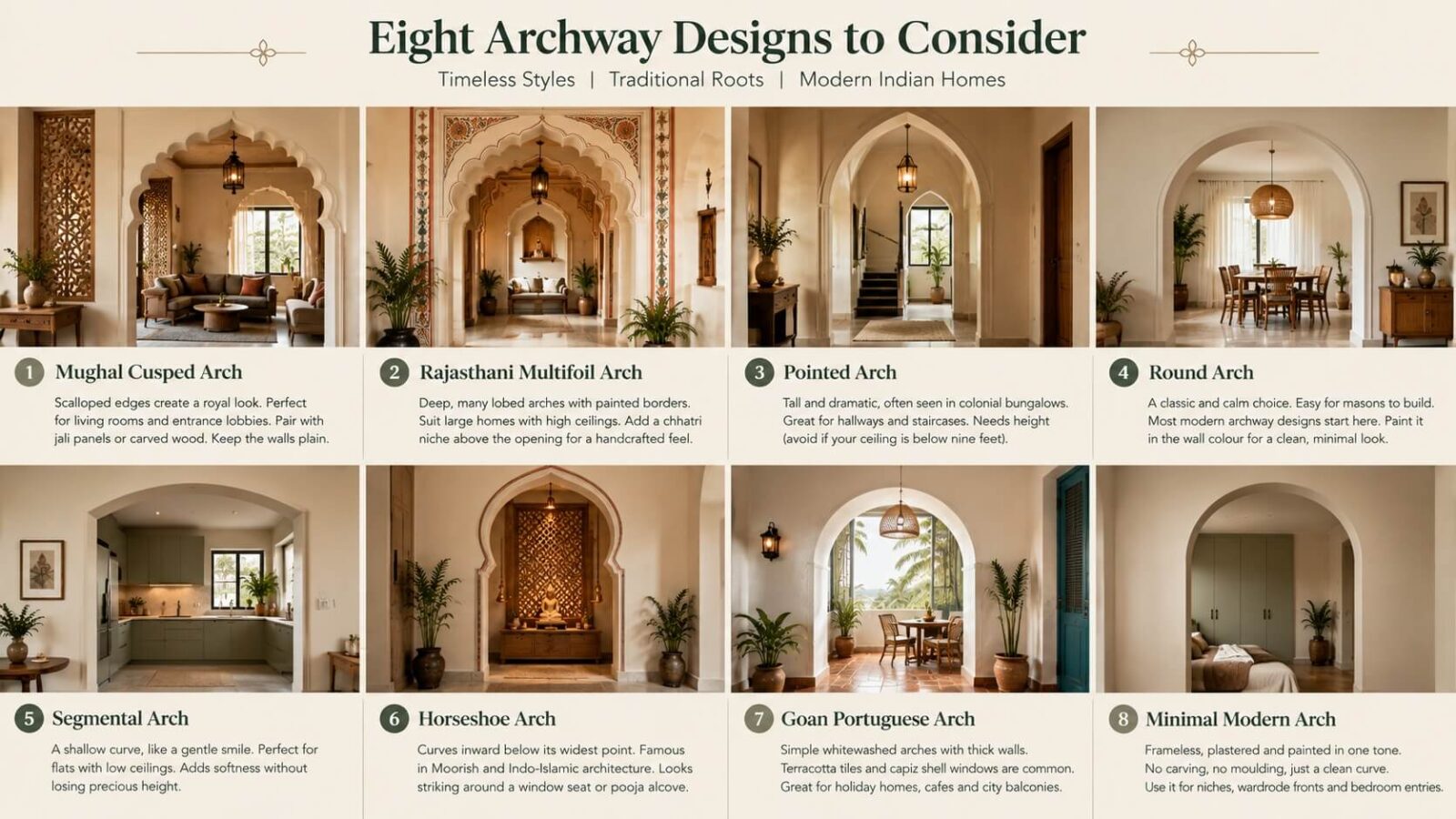
Each style carries its own mood. Pick the one that suits your furniture, not just your saved Pinterest board.
Mughal Cusped Arch
This arch has scalloped edges made of several small curves. It looks royal and suits living rooms and entrance lobbies. Pair it with a jali panel or a carved wooden shutter. Keep the walls around it plain so the shape can shine.
Rajasthani Multifoil Arch
Haveli builders loved deep, many lobed arches with painted borders. They suit large homes with high ceilings. Add a small chhatri style niche above the opening. It gives the wall a layered, handcrafted feel.
Pointed Arch
Colonial era bungalows in India often used tall pointed arches. The shape adds drama to hallways and staircases. It needs height, though. Skip it if your ceiling sits below nine feet.
Round Arch
The semicircular arch is the safest choice. It looks calm and classic, and masons build it easily. Most modern archway designs start here. Paint it in the wall colour for a clean, minimal look.
Segmental Arch
This arch rises only a little above its starting line. It forms a shallow curve, much like a gentle smile.
Flats with low ceilings love it. You get softness without losing precious height.
Horseshoe Arch
The horseshoe arch curves inward below its widest point. Moorish architecture made it famous, and Indo-Islamic buildings borrowed the mood. It looks striking around a window seat or a pooja alcove.
Goan Portuguese Arch
Goan homes use simple whitewashed arches set into thick walls. Terracotta tiles and capiz shell windows often sit nearby. This style suits holiday homes and cafes. It also adapts well to city balconies.
Minimal Modern Arch
Think frameless, plastered and painted in one tone. It has no carving and no moulding, only a clean curve. Use it for niches, wardrobe fronts and bedroom entries.
Here is a quick comparison of these archway designs before you decide.
| Style | Best room | Mood | Ceiling needed | Cost level |
|---|---|---|---|---|
| Mughal cusped | Living room, foyer | Royal | 9 ft or more | High |
| Rajasthani multifoil | Large hall | Festive | 10 ft or more | High |
| Pointed | Hallway, staircase | Dramatic | 9 ft or more | Medium |
| Round | Any room | Classic | 8.5 ft or more | Low |
| Segmental | Apartments | Soft | 8 ft or more | Low |
| Horseshoe | Pooja, window seat | Exotic | 9 ft or more | Medium |
| Goan Portuguese | Balcony, dining | Rustic | 8.5 ft or more | Medium |
| Minimal modern | Bedroom, niches | Modern | 8 ft or more | Low |
Borrow From Your Own Region
Every part of India speaks its own arch language. Use your roots as a design guide.
- Lucknow offers fine cusped arches with lime plaster work.
- Hyderabad gives you bold stone arches from the Qutb Shahi era.
- Gujarat is famous for carved wooden arches in old pol houses.
- Bengal adds triple arched terracotta temple fronts.
A regional reference gives your home a story. Guests may not name the source, but they feel the connection.
Read More: Warm Minimalism
Where to Place Arches at Home
With archway designs, placement matters more than shape. A good arch in the wrong spot feels random.
- Entrance foyer: An arch here makes a strong first impression. It can also screen the shoe rack from the living room.
- Living and dining divider: A wide arch replaces a heavy wall. It separates the zones but keeps them connected.
- Kitchen pass through: A small arched opening lets you serve tea without shouting. Add a counter ledge for trays.
- Bedroom passage: A round arch softens a long corridor. A warm wall light beneath it adds a lovely glow.
- Niches and alcoves: Arched niches display brass diyas, books or art. They need no structural work.
- Wardrobes, mirrors and headboards: These bring the shape home without any construction.
Use archway designs in no more than three places per home. Repetition looks intentional. Overuse looks like a themed restaurant.
Read More: Texture Layering Ideas
Best Materials for Indian Weather
India’s weather tests every material. Delhi brings dust and dry winters. Mumbai brings salt and humidity. Chennai brings heat and moisture together.
Choose your material with your city in mind.
| Material | Best for | Strength | Watch out for |
|---|---|---|---|
| Brick and cement plaster | New builds, structural arches | Very durable | Needs skilled masons |
| Plaster of Paris | Decorative arches in flats | Easy to shape | Cracks at joints, dislikes moisture |
| Gypsum board | Ceiling arches, light frames | Clean finish | Cannot carry heavy loads |
| Solid wood (teak, sal) | Doorways, premium homes | Warm and long lasting | Termites, high cost |
| Plywood or MDF | Wardrobes, niches | Affordable | Swells in humid cities |
| Sandstone or Kota stone | Courtyards, exteriors | Heritage feel | Heavy, needs support |
| GRG or FRP | Ornate cusped designs | Light, highly detailed | Needs expert fitting |
| Wrought iron | Gates, garden arches | Slim profile | Rusts near the coast |
Coastal homes should avoid untreated MDF. Choose marine plywood, FRP or treated wood instead.
Delhi and NCR homes should keep archway designs simple. Deep carving traps dust, and cleaning becomes a weekly chore.
Read More: Living Room Decor Ideas
Check Your Wall Before You Dream
Many Indian apartments use AAC blocks or fly ash bricks for inner partitions. These walls are light, and masons can cut them with ease.
Still, never assume a wall is non load bearing. Ask your builder for the structural drawing.
Safe archway designs always begin with an engineer’s opinion. A beam or lintel must carry the load above the opening.
Apartment societies also set rules. Many need written approval before you open any wall.
Size and Proportion Rules That Work
A few numbers keep your arch comfortable. Treat them as rules of thumb, and adjust them with your designer.
- Clear height: Keep at least seven feet at the highest point of any walkway arch. Taller family members need room.
- Width: Three to four feet suits a single passage. Five to eight feet suits an open divider.
- Rise: A round arch rises half its width. A segmental arch rises one fifth to one third of its width.
- Wall depth: Keep the wall at least four inches thick so the curve reads clearly.
Here is a trick designers love. Cut a full size template from cardboard and hold it in place. Then stand ten feet back. You will judge the curve better than any 3D render can show you.
Four Terms to Know Before You Meet Your Mason
Clear words prevent costly mistakes on site. Learn these four.
- Intrados: The intrados is the inner curve of the arch.
- Apandrel: The spandrel is the triangular patch beside the curve.
- Keystone: The keystone is the block at the very top.
- springing line: The springing line is the level where the curve begins.
Knowing these terms helps you explain archway designs to a mason or carpenter in one conversation.
Vastu Notes for Arches
Vastu experts differ on arches. Treat these notes as guidance, not law.
- Many practitioners prefer rounded forms because they avoid sharp corners. Soft curves suit bedrooms and living areas.
- Keep the centre of the home, called the Brahmasthan, open and light. Avoid placing a heavy or dark arch there.
- The north east zone favours openness. A light, wide arch works better than a bulky carved one.
- Do not aim a pointed arch straight at a bed or desk. Many Vastu readers consider sharp tips unsettling.
Ask your Vastu consultant before you build. They will study your whole floor plan, not just the arch.
Lighting and Colour Ideas
- Light turns a curve into a feature. Run a warm LED strip along the inner edge. Choose 2700K to 3000K for a cosy glow.
- Colour changes the mood fast. Terracotta and ochre suit earthy homes. Indigo and sage suit modern ones.
- Paint the inside of the arch one shade darker than the wall. This adds depth and highlights the shape.
- Brass inlay lines, stencil work or a thin wooden border add craft. Pick only one of them.
- Strong archway designs use a single focal detail. They never stack carving, colour and lights together.
Furniture and Decor That Pair Well
An arch works like a picture frame. The furniture around it tells the story.
Cane chairs and jute rugs bring a relaxed, earthy feel. Low linen sofas suit round and segmental shapes. Brass lamps, handwoven cushions and block print curtains echo the heritage mood. Limit your palette to three colours. In a modern flat, choose slim legged furniture and matte finishes. Let the arch stay the boldest curve in the room. During the festive season, hang a marigold toran along the curve. The arch becomes a ready made welcome frame.
Low Cost Ways to Try Archway Designs
Not every home allows structural change. Rented flats rarely do.
Hang an arched mirror above a console. Fit a removable arched panel inside a rectangular door frame. Paint an arch behind your sofa or bed.
Painted arches cost little and look striking. Use painter’s tape and a string compass to draw a clean curve.
These tricks let you test archway designs before you commit to masonry.
Mistakes to Avoid
Most regrets with archway designs come from rushed decisions. Watch for these common errors.
- Do not mix too many arch styles. Pick one family and stay loyal to it.
- Decide early whether the opening needs a door shutter. Fitting a shutter to a curved frame later costs more.
- Measure your sofa and almirah before you fix the width. Furniture must fit through the opening.
Care and Maintenance
Well made archway designs need little care, but small habits help.
- Dust carved surfaces with a soft brush every week.
- Wipe painted curves with a damp cloth, never a wet one.
- Watch for hairline cracks where the arch meets the wall.
- Fill them with flexible filler and fibre mesh tape before painting.
Final Thoughts
Archway designs connect old Indian craft with today’s tastes. They need planning, but the payoff lasts for years. Start with one arch. Choose a style that fits your ceiling, climate and budget. Test it with cardboard, check the structure and then build. Do it well, and a simple curve will make your whole home feel warmer.
Frequently Asked Questions
1. What are the best archway designs for small Indian apartments?
Choose a segmental or round arch with a minimal finish. These shapes protect your ceiling height. Paint them in the wall colour and add a warm LED strip. Avoid heavy carving and tall pointed shapes in rooms below nine feet.
2. Can I build an arch in a rented or society flat?
Check your lease and society rules first. Many societies need approval for any structural change. If you cannot build, use arched mirrors, painted arches or removable panels instead.
3. How much does an arch cost in India?
Cost depends on your city, material and level of detail. A plain plaster or gypsum arch costs far less than carved teak or GRG. Ask for a per arch quote, with material and labour listed separately. Compare at least three quotes.
4. Do arches suit Vastu principles?
Most Vastu experts accept rounded arches that keep the Brahmasthan open. They advise against sharp pointed tips aimed at beds or desks. Share your floor plan with a consultant for advice that fits your home.
