

Delhi’s urban story is entering a fresh chapter. On 12 August 2026, the Delhi Development Authority approved the draft Delhi Master plan for 2047, replacing the long-pending Master Plan of Delhi 2041, which had remained stuck in the approval stage since it was cleared in February 2023. The new plan has been aligned with the Central Government’s Viksit Bharat @ 2047 vision, giving Delhi’s urban growth a fresh timeline and a fresh direction.
For anyone tracking property trends in the National Capital Region, this development matters enormously. A statutory land use document of this scale does not merely guide bureaucratic paperwork. It decides where housing can come up, which areas open for commercial construction, how old buildings get redeveloped, and how the city’s floodplains and green belts are treated. In short, the Delhi Master plan for 2047 will influence property prices, investment patterns and the physical shape of Delhi NCR for the next two decades and beyond.
This blog breaks down what the plan contains, why it replaced MPD 2041, and what it practically means for homebuyers, investors and developers across the region.
What Is the Delhi Master plan for 2047
The Master Plan for Delhi is a statutory document that has guided the capital’s growth since 1962, followed by revisions in 2001 and 2021. Each version has typically covered a twenty year horizon, addressing zoning, housing, transport, infrastructure and environmental protection.
Work on the next edition began years ago as MPD 2041, but it never reached formal notification despite being approved by the DDA in 2023. It repeatedly missed deadlines set by the Central Government. Rather than continuing to push an outdated timeline, the DDA rebranded and updated the document as the Delhi Master plan for 2047, syncing Delhi’s own growth blueprint with the nation’s Viksit Bharat 2047 vision. The approval meeting was chaired by Delhi Lieutenant Governor Taranjit Singh Sandhu, with DDA Vice Chairman N Saravana Kumar in attendance.
The plan has now been sent to the Union Ministry of Housing and Urban Affairs for final approval and subsequent notification. Until that notification happens, the document remains a draft, though its broad direction gives the real estate industry a strong indication of what lies ahead.
Key Highlights of the Delhi Master plan for 2047
A few provisions stand out clearly from the approved draft.
- Commercial construction in peripheral villages: The plan permits commercial construction in 70 peripheral villages located along the edges of Delhi. This single decision could unlock significant new development potential in areas that were previously restricted, opening fresh avenues for retail, warehousing and mixed use projects near the city’s boundary with Haryana and Uttar Pradesh.
- Yamuna floodplain relaxation: The draft relaxes developmental protections on a portion of the Yamuna floodplain. This is one of the more debated aspects of the plan, since floodplain land has historically been treated as ecologically sensitive and largely off limits for construction.
- Metro depot land use change: A change in land use has been approved for a metro depot connected to the Rithala-Kundli corridor in Narela, supporting the expansion of Delhi Metro into the northern periphery.
- Redevelopment policy for old DDA housing: The DDA has approved a uniform policy for the reconstruction and redevelopment of structurally deficient, DDA-built two storey dwelling units that are more than 50 years old. This addresses thousands of ageing housing units across colonies developed decades ago.
- Integrated planning approach: According to the DDA, the plan adopts an integrated approach spanning housing, economic growth, mobility, environmental sustainability, infrastructure, heritage conservation, urban regeneration and citizen centric governance, rather than treating each area as a separate policy silo.
Together, these provisions make the Delhi Master plan for 2047 one of the most consequential planning documents Delhi has seen in recent years.
How the Delhi Master Plan for 2047 Will Reshape Real Estate in Delhi NCR
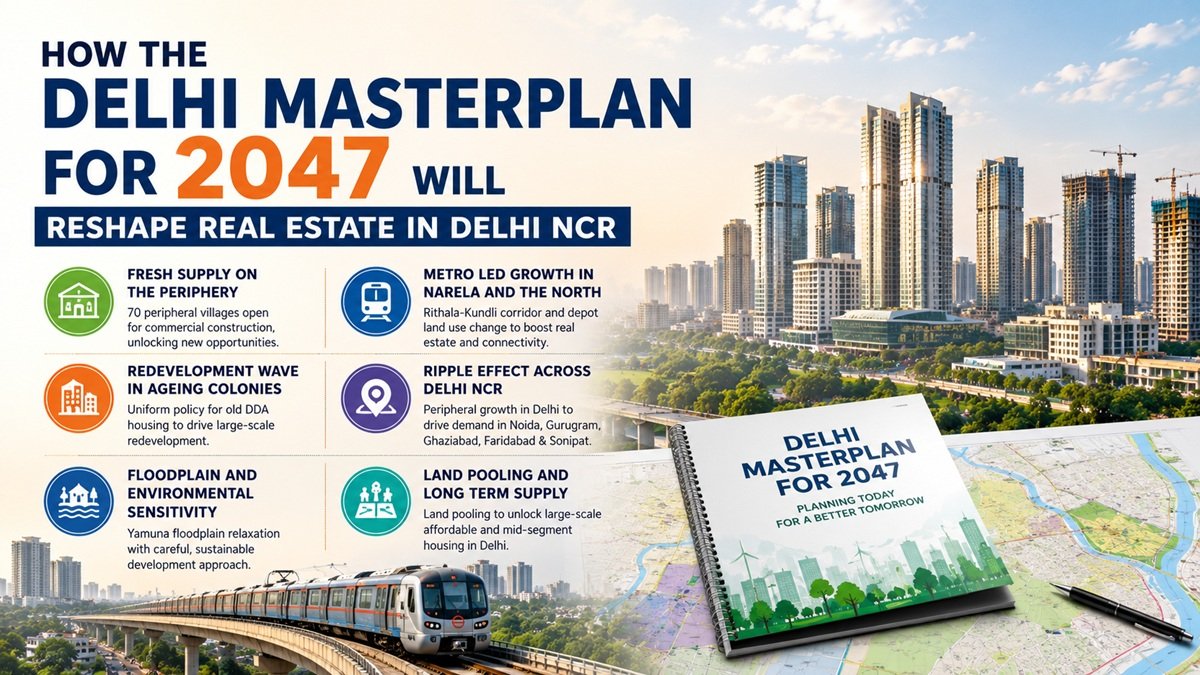
Fresh Supply on the Periphery
The opening up of 70 peripheral villages for commercial construction is likely to be the biggest real estate trigger. Land parcels that were previously locked under restrictive zoning could now see warehousing hubs, neighbourhood retail, and commercial complexes. Investors who have been holding land in these fringe areas may finally see movement, and developers will likely start scouting these zones for early stage acquisitions.
Redevelopment Wave in Ageing Colonies
The uniform redevelopment policy for old two storey DDA housing could set off a wave of reconstruction across colonies that are more than five decades old. For residents, this offers the possibility of modern, safer housing on the same plots. For developers, it opens a redevelopment segment that has long been discussed but rarely executed at scale in Delhi. Expect this to become a active category within the broader Delhi Master Plan for 2047 framework, similar to how redevelopment has reshaped parts of Mumbai.
Floodplain and Environmental Sensitivity
The relaxation on the Yamuna floodplain is likely to draw attention from both developers and environmentalists. While it could free up land near the river for certain kinds of development, any construction here will need to be handled carefully, given Delhi’s recurring flooding and pollution concerns. Buyers evaluating projects near the floodplain should track how the final notified plan defines permissible use, since this remains one of the more sensitive components of the Delhi Master Plan for 2047.
Metro Led Growth in Narela and the North
The land use change for the metro depot supporting the Rithala-Kundli corridor signals continued investment in Delhi’s northern periphery. Areas like Narela have historically lagged behind central and south Delhi in real estate activity, but improved metro connectivity typically pushes up both residential demand and land values along the corridor. This is a pattern investors have seen play out along earlier metro extensions across NCR, from Dwarka Expressway to the Yellow Line extension into Haryana.
Ripple Effect Across Delhi NCR
Delhi rarely grows in isolation from the wider National Capital Region. As Delhi’s periphery opens up under the Delhi Master Plan for 2047, neighbouring markets such as Noida, Gurugram, Faridabad, Ghaziabad and Sonipat are likely to feel the ripple effect. Improved connectivity and commercial activity near Delhi’s borders often pushes developers to look at adjoining NCR belts for complementary projects, whether that is logistics parks, affordable housing, or mixed use townships.
Land Pooling and Long Term Supply
Although land pooling was a central feature of the earlier MPD 2041 draft, its treatment under the new plan will be closely watched once the full document is notified. Land pooling, where private landowners pool their plots with the DDA for planned development, has been positioned as a way to unlock large scale affordable and mid segment housing supply. If carried forward meaningfully in the Delhi Master Plan for 2047, it could become one of the biggest sources of new housing stock in Delhi over the coming decade.
Challenges and the Road Ahead
It is worth remembering that the plan is still a draft. The previous version, MPD 2041, was approved by the DDA back in 2023 but never reached formal notification, missing several deadlines set by the Centre. The Delhi Master Plan for 2047 now needs to go through the Ministry of Housing and Urban Affairs before it becomes legally enforceable.
Given this history, real estate stakeholders would do well to treat the current draft as a strong directional signal rather than a finalised regulation. Timelines for such large planning documents in Delhi have historically stretched over years, and the pace of the actual notification process will determine how quickly the on ground changes described above start to materialise.
There are also implementation questions to watch. How will infrastructure such as roads, water supply and sewage keep pace with commercial construction in newly opened peripheral villages? How will floodplain relaxations be balanced against Delhi’s flooding history? How will redevelopment of old housing be financed and executed at scale? These are the practical questions that will decide whether the Delhi Master plan for 2047 delivers on its promise or faces the same delays that troubled its predecessor.
Conclusion
The approval of the Delhi Master plan for 2047 marks a genuine shift in how Delhi plans to grow over the next two decades. From opening peripheral villages for commercial use to relaxing floodplain restrictions, supporting metro expansion in the north, and introducing a redevelopment policy for old housing, the plan touches nearly every corner of the city’s real estate landscape. For homebuyers and investors across Delhi NCR, the coming months, as the plan moves toward formal notification, will be worth watching closely, since the final shape of this document is likely to influence property decisions for years to come.
Ready to make sense of how Delhi’s changing master plan affects your next property decision? Explore Zen Nest Living for well researched real estate guides, locality insights and practical buying advice tailored to Delhi NCR, and plan your next move with confidence. Want to know more about housing, real estate, home decor, vastu, etc., contact us now.
Frequently Asked Questions
1. What is the Delhi Master plan for 2047?
It is the statutory land use and development plan approved by the DDA on 12 August 2026, replacing the earlier MPD 2041 draft and aligned with the Centre’s Viksit Bharat @ 2047 vision. It covers zoning, housing, transport, infrastructure and environmental regulation across Delhi.
2. Has the Delhi Master plan for 2047 been officially notified?
No. The plan has only been approved by the DDA so far. It has been sent to the Union Ministry of Housing and Urban Affairs for final approval and notification, which is the step that will make it legally enforceable.
3. Which areas will benefit most from the new plan?
Peripheral villages along Delhi’s edges are set to benefit from newly permitted commercial construction, while northern areas like Narela could see growth linked to the Rithala-Kundli metro corridor. Old DDA colonies eligible for redevelopment will also see fresh activity.
4. How does this plan affect Noida, Gurugram and other NCR cities?
While the plan is specific to Delhi, its focus on peripheral development and connectivity is likely to have a spillover effect on bordering NCR markets, encouraging complementary residential, commercial and logistics development in adjoining cities.